
What an AI clause in a creative contract can hand over, the numbers behind the shift, and nine questions to ask before you sign.
In April 2026, a voice actor on Reddit asked whether anyone else was seeing contracts with “unlimited transformation rights, perpetual licenses, or work-for-hire clauses” that could let a client use recordings to train AI models indefinitely. The replies were blunt, and one was practical: before you sign, search the PDF for “artificial,” “machine learning,” “perpetuity” and “train.” That habit is worth building. AI language now appears in book deals, design contracts and game agreements. It cuts both ways. Some clauses grab training rights. Others promise that you will not use AI at all.
Short Answer
An AI clause decides whether a client or publisher can use your work to train AI, create AI outputs or run your work through chatbots, and if you may use AI yourself. Before signing, ask who owns the work and if training rights are granted or reserved. Then check the pay for AI uses, how long the rights last and what happens if the clause is broken. If the contract says nothing about AI, ask for a clause that reserves those rights to you.
Table of Contents
What the numbers say about AI and creative work
There is no national count of how many creative contracts include AI clauses yet, but several data points show why they matter:
- Lost work is already measurable. A Society of Authors survey in the UK found that 26% of illustrators and 36% of translators had already lost work to generative AI. It also found 37% of illustrators and 43% of translators said their income had lost value.
- Some creators are told to use AI. In the same survey, 5% of illustrators and 8% of translators said they had used generative AI because a publisher or commissioning organization asked them to.
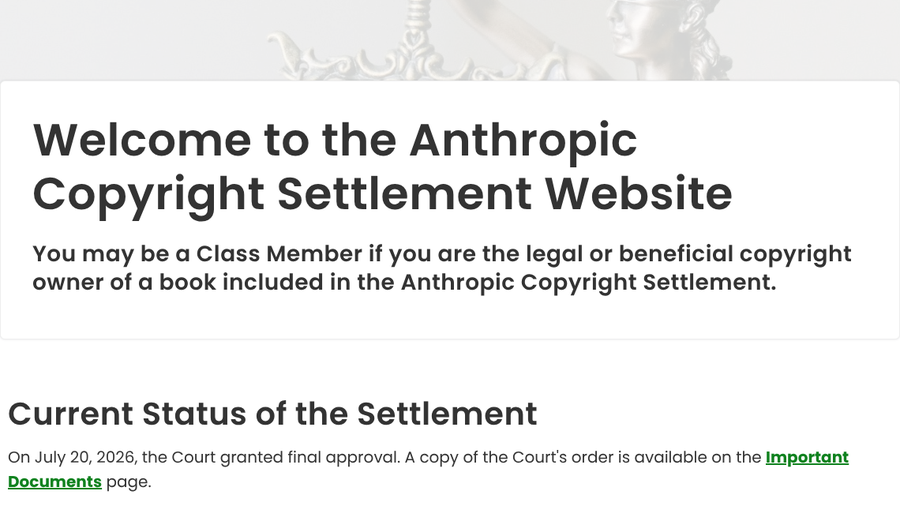
- Training has a price tag now. The Anthropic copyright settlement received final court approval on July 20, 2026. Its FAQ says it provides about $3,000 per book and calls it the largest copyright class action settlement in history.
- Clients are writing anti-AI clauses too. In August 2026, game lawyer Haley MacLean told GamesRadar+ that virtually all of her indie and AA studio clients now explicitly oppose generative AI in their contracts.

Put together, the pattern is clear. Your work has value as training data, and some clients want to ban AI from your process entirely. A contract that ignores AI leaves both questions open.
9 questions to ask about any AI clause
1. Does the contract mention AI at all?
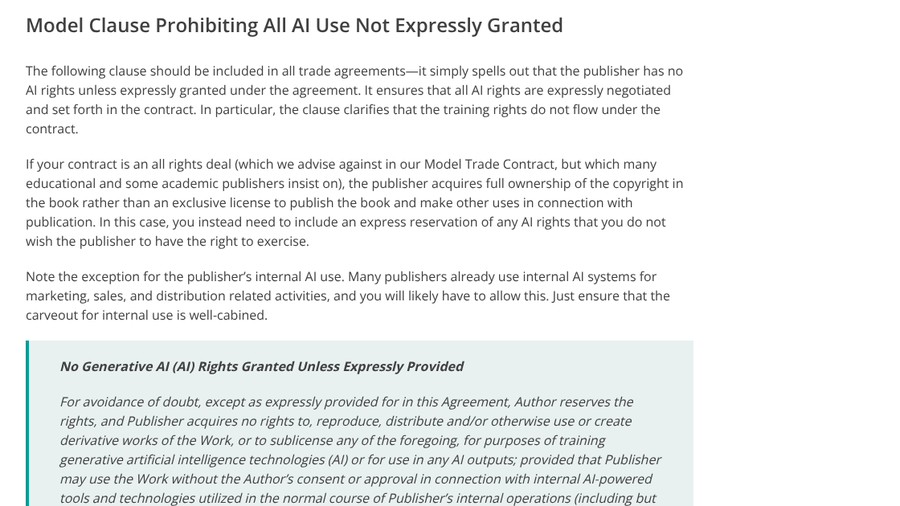
Silence is not protection. Broad language such as “all media now known or later developed” or a full assignment of rights can arguably cover training uses nobody discussed. The Authors Guild’s model AI clauses put it simply: “any and all grants of AI rights to publishers should be expressly negotiated.” If AI is missing, ask for a sentence that reserves AI training and output rights to you unless they are specifically granted.
2. Are you licensing the work or giving it away?
A license lets a client use your work in defined ways. A work-for-hire agreement or full assignment gives them ownership, and with it, most decisions about AI. The Authors Guild notes that in an all-rights deal, you need an express reservation of any AI rights you do not want the publisher to exercise.
3. Is AI training separated from publishing and marketing?
Many publishers already use internal AI tools for marketing, sales and search, and the Guild says authors will likely have to allow that. The key is keeping the carve-out narrow, limited to internal operations, so it cannot become a back door to licensing your work to an AI developer.
4. How long do the rights last, and can they be passed on?
Watch for “perpetual,” “irrevocable,” “worldwide” and “sublicensable” in the same sentence as AI, voice or likeness. Those words together mean the client could hand your work or voice to someone else, forever. Time limits and a ban on sublicensing are reasonable asks.
5. Do you get paid separately for AI uses?
If you are willing to license AI uses, treat them like other subsidiary rights, with their own fee or split. The Guild warns that, unless the contract says otherwise, income from AI licenses is typically applied against your advance, so ask for it to flow to you directly or be priced into the deal.
6. Will your work be uploaded into chatbots?
Editors and clients sometimes paste drafts into consumer AI tools for summaries or marketing copy. In an April 2026 statement, the Authors Guild recommended a clause barring publishers from uploading a manuscript or an author’s personal information to consumer-facing AI without written permission, and requiring training opt-outs when permission is given.
7. Can the client use AI to alter your work or copy your style or voice?
This matters most for illustrators, designers and voice actors. Ask whether the client may use AI to generate variations, extend your artwork or create a synthetic version of your voice, and require your written approval for each use. The Guild’s model clauses give authors approval rights over AI use in audiobooks, translations and cover art.
8. Are you promising not to use AI?
The newer risk runs the other way. Anti-AI warranties ask you to guarantee your work contains no AI-generated material, sometimes with an indemnity if a claim arises. Clarify what counts: spell-check, noise reduction and some photo tools now include AI features. Agree on a definition, and cap your liability.
9. What happens if someone breaks the clause?
A clause without consequences is a suggestion. In March 2026, a graphic designer on Reddit shared a new clause barring clients from feeding draft concepts into AI during revisions. Commenters said it needed a remedy, such as extra fees for reworking AI-altered feedback or the right to end the project. Another pointed out that a clear contract also filters out clients who would not respect it.
Weak wording to push back on
Some clauses sound protective but are not. In an April 2026 thread about a podcast voice contract, a commenter flagged a line promising that the producer would “make every reasonable effort to contact you to obtain your express written permission” before reusing recordings. As the commenter noted, that is not the same as needing your permission. Replace effort language with a firm requirement, such as “shall not use without the Artist’s prior written consent.”
If a deal also includes behavior or reputation terms, our explainer on how morality clauses work in talent and influencer deals covers what to check there. And if a new client’s first move is to overpay you, read our guide to the art commission overpayment scam before you do anything else.
This article is for general information only and is not legal advice. Contract terms and copyright rules vary by country and industry, so have a lawyer or your professional association review any contract before you sign.
Key Takeaways
- Search every contract for AI, machine learning, training, perpetual and sublicense before signing.
- If AI is not mentioned, ask for a clause that reserves training and output rights to you.
- License AI uses separately, with their own pay, time limits and approval rights.
- Treat no-AI warranties seriously, and agree on a definition and a liability cap.
Frequently Asked Questions
What is an AI clause in a contract?
An AI clause is a contract term that controls how artificial intelligence can be used with the work, such as whether the client can use it to train AI models, create AI outputs or upload it to chatbots. It can also limit whether the creator may use AI to make the work.
Can a client use my work to train AI?
A client may be able to use your work to train AI if the contract grants broad rights or transfers ownership. The safest approach is a clause stating that AI training rights are reserved to you unless expressly granted in writing.
Should I sign a contract that includes AI training rights?
Only sign a contract with AI training rights if you understand exactly what is granted and are paid for it. Look for limits on time, scope and sublicensing, and ask for approval rights over any use of your voice, likeness or style.
What should a no-AI clause for artists include?
A no-AI clause should state that the client acquires no rights to use the work for AI training or outputs unless expressly granted. It should also bar uploading the work to AI tools without permission and set a remedy if the clause is broken.
Can I get paid if my book was used to train AI?
Owners of eligible books can be paid through the Anthropic copyright settlement, which provides about $3,000 per book on its works list. Other AI copyright lawsuits are ongoing, so check your contract and your publisher’s AI policy for any licensing terms.
What To Do Next
Pull up your current contract templates and any agreements you are about to sign. Search them for AI-related terms, then decide what you are willing to license and for how much. Add a short reservation clause to your own template, and bring a list of these nine questions to your next negotiation. If you belong to a guild or union, check whether it offers free contract reviews.