
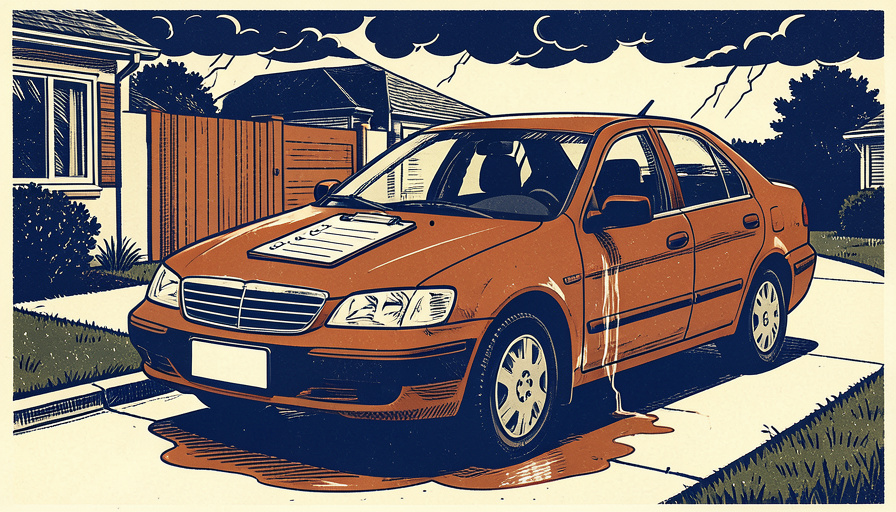
Five Carfax alternatives that screen used cars for flood damage, salvage brands and total-loss history, using free checks and one-time reports instead of a monthly plan.
A single Carfax report costs $44.99, which is fine for the one car you plan to buy and painful when you are still comparing six listings. In August 2026, one shopper who likes to browse rebuilt-title cars said they did not want to spend “50 bucks on a VIN check every time.” The good news is that the checks that matter most for flood and salvage history are cheap or free. Some of them even catch problems a clean Carfax or AutoCheck report can miss, because they pull from the federal title database that consumer reports from those two companies do not include.
The best Carfax alternatives for flood and salvage checks in 2026 are:
- NICB VINCheck: best free first screen for insurer salvage and flood records
- VinAudit: best cheap NMVTIS title-brand report
- ClearVin: best for past auction photos of damage
- AutoCheck: best free flood-risk check plus a one-time full report
- iSeeCars VIN Check: best free listing and price history
Quick Picks
| Tool | Best For | Price | Flood and Salvage Data | NMVTIS Report | Subscription Needed |
|---|---|---|---|---|---|
| NICB VINCheck | Free first screen | Free, 5 searches a day | Insurer salvage, flood and theft records | No | No |
| VinAudit | Cheapest title-brand check | $9.99; 5 for $19.99 | State title brands, junk and salvage reports | Yes | No |
| ClearVin | Auction damage photos | $17.99; 5 for $28.99 | Title brands plus past sale photos | Yes | No |
| AutoCheck | Free flood-risk screen | Flood check free; report $29.99 | Flood brands, auction flood notes, FEMA areas | No | No |
| iSeeCars VIN Check | Listing and price history | Free; optional plans from $19/mo | Title and accident info when available | No | Optional |
Table of Contents
Why buyers look for Carfax alternatives
Price is the obvious reason. The less obvious one is data coverage. The National Motor Vehicle Title Information System, or NMVTIS, is the federal database built to keep stolen cars and unsafe vehicles from being resold, and state titling agencies across the country report to it. The Justice Department’s list of approved NMVTIS report providers carries a note many buyers never see: consumers cannot receive NMVTIS vehicle history reports from Carfax or Experian, because those companies provide that information only to car dealerships.
That gap has real consequences. In June 2026, a buyer on Reddit described a 2018 car bought from a North Carolina dealer in 2024 with an AutoCheck report showing a clean title. After a move to Florida, the state ran the VIN through NMVTIS, found a junk or salvage record from 2022 and refused to renew the registration. Another commenter described a hail-damaged car declared a total loss in Colorado that later carried a clean Utah title until a move to a third state. Title washing like this is why a flood or salvage check should include at least one NMVTIS report.
1. NICB VINCheck

Best for: A free first screen on every car you are considering.
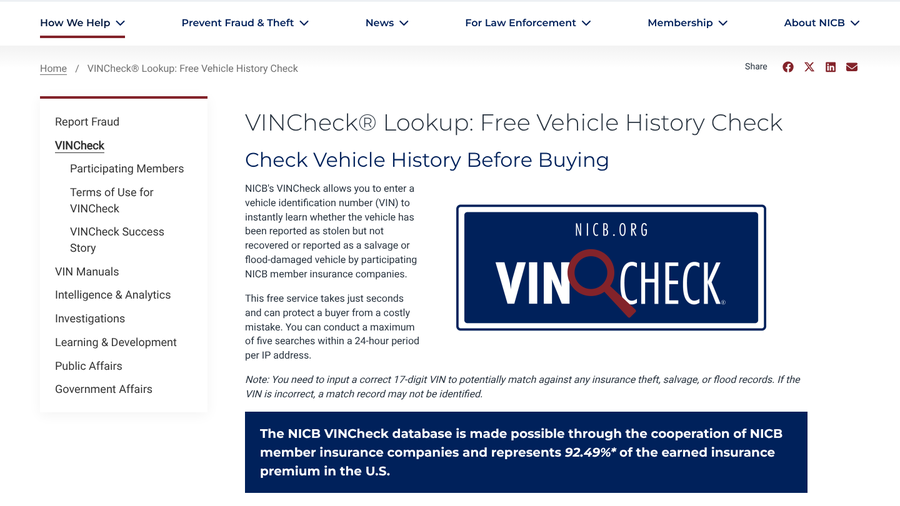
The National Insurance Crime Bureau is a nonprofit backed by member insurance companies, and its VINCheck lookup tells you whether a vehicle has been reported as stolen and not recovered, or reported as a salvage or flood-damaged vehicle by participating NICB member insurance companies. NICB says those participating members represent 92.49% of the earned insurance premium in the U.S., so a large share of insurance total losses should show up.
The limits matter as much. VINCheck only shows insurance records from participating companies. It does not search law enforcement records, and it cannot see damage that never became an insurance claim, such as a flooded car whose owner carried only liability coverage and dried it out to sell. NICB itself warns that VINCheck is not a full vehicle history report and should not be the only thing you rely on before buying.
Treat it as a filter. If a car you like comes back with a salvage or flood record, you have saved the cost of a paid report and can move on. If it comes back clean, that tells you no participating insurer has reported it, not that the car is clean. You also need the full 17-digit VIN, since a typo means no match. If the car comes from a storm-hit area, run the check again right before you pay, because insurance total-loss reports can take time to appear. The lookup page itself currently points storm-affected visitors to NICB’s disaster fraud resources.
- Pros: Completely free, no account needed, and backed by insurer data that covers most of the U.S. market. Results arrive in seconds.
- Cons: Limited to five searches per 24 hours per IP address, shows only participating insurers’ records and says nothing about accidents, owners or service history.
Pricing: Free, up to five searches in 24 hours.
2. VinAudit
Best for: The cheapest way to see a car’s title brands from NMVTIS.
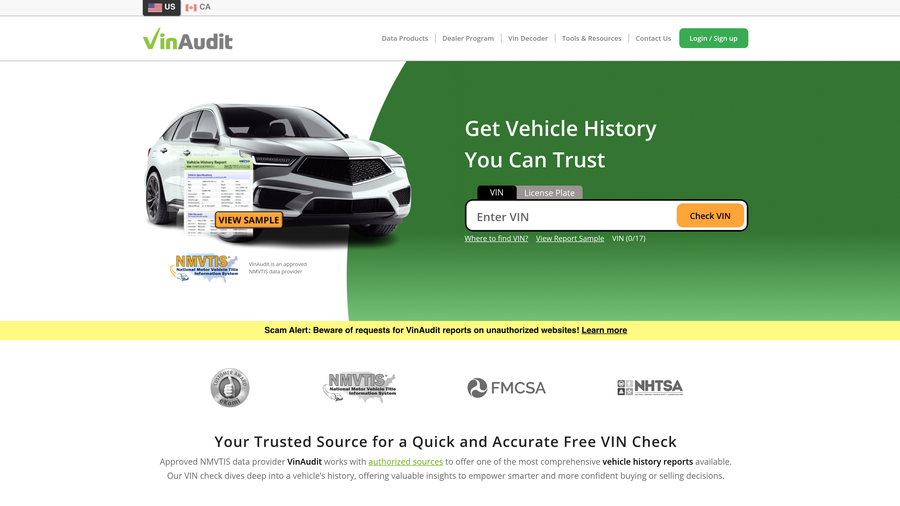
VinAudit is an approved NMVTIS data provider, and that is the reason it belongs on a flood and salvage list. An NMVTIS report shows title brands recorded by state motor vehicle agencies, such as flood, salvage and junk. It also includes reports that junk yards, salvage yards and insurers must file. That is the record that tripped up the North Carolina buyer, and it is the one a dealer’s Carfax or AutoCheck printout does not give you directly.
The pricing makes it easy to run on every serious candidate. VinAudit charges $9.99 for a single report, $19.99 for five and $29.99 for ten, and there is no monthly plan to cancel. If you are down to three cars, the five-pack costs less than half of one Carfax report. You can search by VIN or license plate, and a sample report link sits right under the search box so you can see the layout first.
Expect a plainer report than Carfax. VinAudit’s strength is title and brand history, so do not count on detailed service records or a long list of oil changes. Treat it as the title check and pair it with a mechanic’s inspection for condition.
One more practical note: VinAudit runs a scam alert on its homepage about requests for VinAudit reports on unauthorized websites. Fake sellers sometimes insist a buyer purchase a “history report” through a link they send, which is a payment grab. Always type vinaudit.com into your browser yourself rather than using a seller’s link.
- Pros: Official NMVTIS data, the lowest per-report price on this list, bundles with no recurring charge and a sample report you can preview before buying.
- Cons: Fewer service and accident details than Carfax, a dated look, and data only as complete as each state’s reporting.
Pricing: $9.99 for one report, $19.99 for five, $29.99 for ten.
3. ClearVin
Best for: Seeing photos from a car’s past sales or salvage auctions.
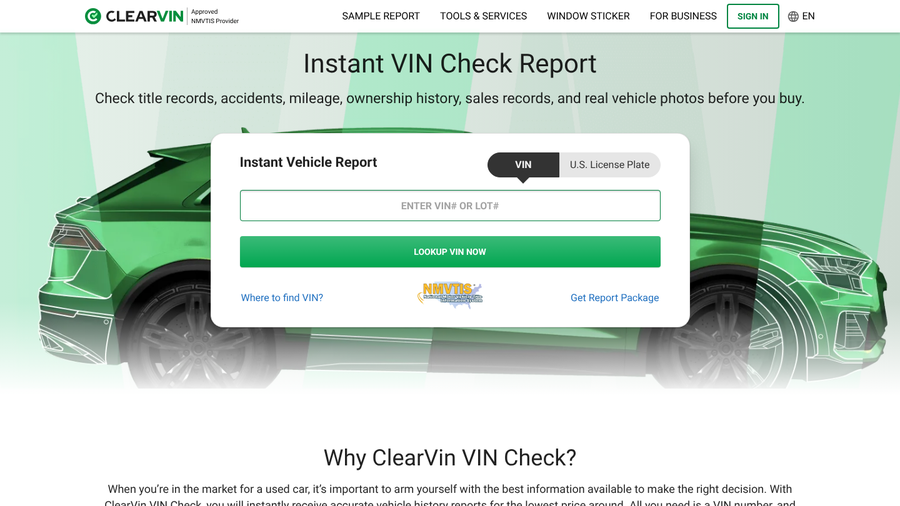
ClearVin is also an approved NMVTIS provider, but its selling point is pictures. ClearVin says its reports cover title records, accidents, mileage and ownership history. They also include sales records and real vehicle photos from earlier listings and auctions, along with price changes between sales. For flood cars, that is often the most convincing evidence you can get: a car photographed on a salvage lot with a water line on the upholstery tells you more than any title code.
It also helps that ClearVin shows a free preview before you pay. When we entered a VIN, the checkout page flagged that the vehicle “might have been damaged” and listed which record types were found, such as ownership and DMV title history. That lets you skip buying a report on a car that shows nothing worth checking, or buy one on a car that clearly needs a closer look. You can search by VIN, U.S. license plate or auction lot number.
Photos depend on where a car has been. A vehicle that went through a salvage auction or was listed online several times will usually have far more images than one that stayed with a single owner, so a thin photo section is not proof of anything. ClearVin’s monthly plan is aimed at dealers, so private buyers simply pay per report. The site also offers window sticker lookups, which help confirm that a listing’s trim and options match what the seller claims.
- Pros: NMVTIS title data plus past sale and auction photos, a free preview showing which records exist, and one-time pricing with card or PayPal.
- Cons: Costs more per single report than VinAudit, the best value is the five-pack, and photo coverage varies widely by vehicle.
Pricing: $17.99 for one report, $23.98 for two, $28.99 for five.
4. AutoCheck
Best for: A free flood-risk screen and, when needed, a cheaper full report than Carfax.
AutoCheck, owned by Experian, is the closest paid rival to Carfax, and it has a free tool that fits this list well. Its Flood Risk Check tells you whether a car was titled or registered in the previous 12 months in a county declared a FEMA major disaster area. It also searches Experian’s flood title and problem records, including state flood brands, auction flood announcements and salvage auction flood designations. Experian is careful to say that a result with no records does not guarantee a car was never flooded, and it recommends an independent inspection.
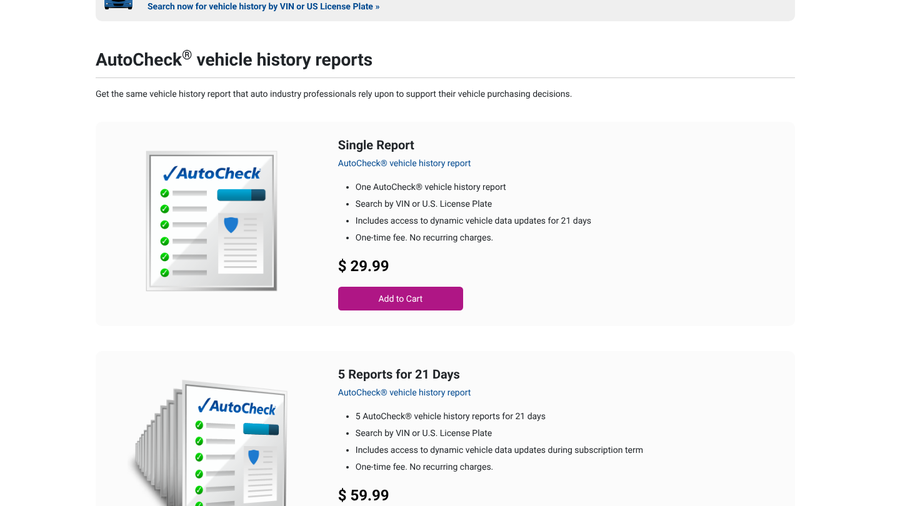
If a car passes the free checks and you want a fuller picture, the paid report costs less than Carfax. AutoCheck charges $29.99 for one report with 21 days of data updates, or $59.99 for five reports used within 21 days. Both are one-time fees with no recurring charges. AutoCheck’s report searches for salvage or junk records, damage from hail, flood or fire, odometer problems and lemon history. It also includes the AutoCheck Score and buyback protection for qualifying vehicles. Our comparison of Carfax vs AutoCheck on odometer fraud covers where each report is stronger.
The catch is the NMVTIS gap. Because consumers cannot get NMVTIS reports from Experian, an AutoCheck report is not a substitute for an NMVTIS check, as the Florida registration case shows. Use AutoCheck for auction and flood-risk data, and add a VinAudit or ClearVin report for the title brands.
- Pros: Free FEMA-based flood risk screen, auction data from Experian, and a five-report pack that costs about the same as a single Carfax report.
- Cons: The consumer report is not an NMVTIS report, and the 21-day window means you need to use a five-pack quickly.
Pricing: Flood Risk Check free. Full report $29.99, or five reports for $59.99 within 21 days.
5. iSeeCars VIN Check
Best for: Free listing history, market value and recall checks while you are still browsing.
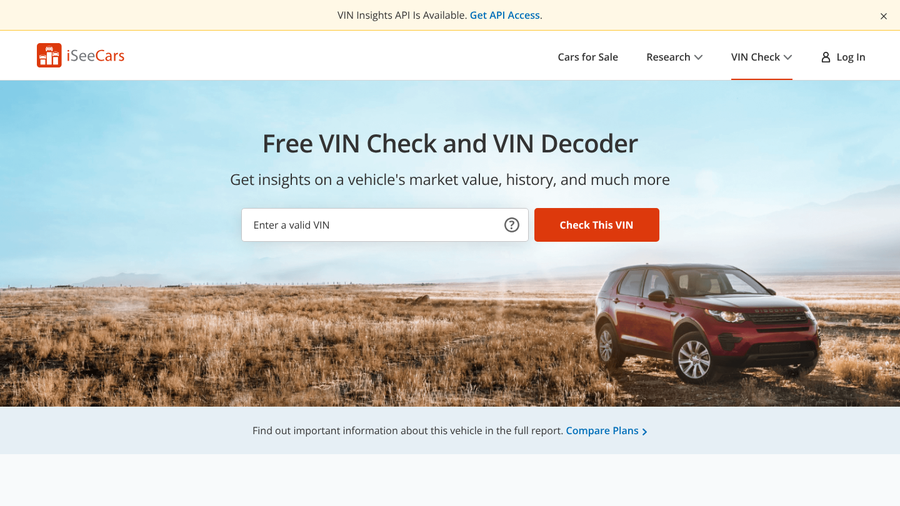
The iSeeCars VIN Check is free and gives you more than a VIN decoder. It covers market value, selling history and a theft record check. It also shows past and open recalls, title and lien information, and an accident check, though some items appear only when data is available. The listing history is the underrated part: it shows when and at what price a car was advertised before, which helps you spot a car that keeps getting relisted or has bounced between sellers.
That makes iSeeCars a good browsing tool rather than a final check. A car with a suspicious price drop, several relistings or an open recall is worth questioning before you spend money on any report. You can also set alerts for market value changes and new recalls on a VIN you are watching. Because the free check runs through the site’s VIN decoder, it also confirms the year, trim and engine, so you can compare them with what the seller listed.
Be aware of the upsell. iSeeCars sells iVIN plans for heavier use, with iVIN Lite listed at $19 a month for 50 reports and iVIN Pro at $49 a month for 200. Both prices are listed as discounts from $39 and $79. The Lite plan adds a report summary with accident and stolen-car checks, and Pro adds local market reports by ZIP code. Most private buyers never need either, since the free check plus one NMVTIS report covers the flood and salvage question.
- Pros: Free with no report limit on the basic check, useful price and listing history, and recall alerts for cars you are tracking.
- Cons: Title and accident details depend on data availability, it is not an NMVTIS report, and the site pushes monthly plans.
Pricing: Free VIN check. Optional iVIN plans cost $19 a month (Lite) or $49 a month (Pro).
A flood and salvage check routine for under $20
- Search the VIN on Google. Shoppers on Reddit repeatedly recommend this first, because cars that went through an auction often still have lot photos and damage notes online.
- Run NICB VINCheck. It is free and filters out cars an insurer already declared salvage or flood-damaged.
- Run AutoCheck’s Flood Risk Check. Look closely at any car registered in a FEMA disaster county in the past year.
- Buy one NMVTIS report for the finalist. VinAudit at $9.99 covers the title brands, or ClearVin if you want auction photos.
- Get a pre-purchase inspection. Ask the mechanic to check for a musty smell, dried silt under the carpets and rust on seat bolts and wiring connectors.
Two things to avoid along the way. Some sites advertise a $1 trial that turns into a membership; EpicVIN’s own pricing page says that after a three-day trial you are billed $49.99 a month. And skip cheap “Carfax” reports sold by marketplace resellers, since you cannot verify where they came from. If the car checks out, our guide to DMV title transfer mistakes in a private sale covers the paperwork.
How We Chose These
Every tool here had to help answer one question: has this car been flooded, salvaged or declared a total loss? We favored official data first, which meant NMVTIS title records and insurer records, and then tools that add evidence such as auction photos or disaster-area registration. Each option had to be usable without a monthly subscription, either free or sold as a one-time report, and we checked current prices on each provider’s own site. Services whose entry price is a trial that converts to a membership were left out. We also weighed how easy each tool is for a private buyer comparing several cars over a weekend.
The Bottom Line
If you only do one thing, run every listing through NICB VINCheck and AutoCheck’s Flood Risk Check, since both are free. For the car you plan to buy, get an NMVTIS report from VinAudit for the lowest price, or from ClearVin if you want to see past auction photos. Buy a full AutoCheck report when you want auction and accident detail for less than Carfax charges, and use iSeeCars while you are still browsing. None of these replace a mechanic’s inspection, which is still the best way to find flood damage nobody reported.
Frequently Asked Questions
What is the best Carfax alternative?
The best Carfax alternative for flood and salvage checks is an NMVTIS report from an approved provider such as VinAudit, which costs $9.99. Pair it with the free NICB VINCheck and AutoCheck Flood Risk Check to screen for insurer and flood records at little or no cost.
Is AutoCheck better than Carfax for spotting flood damage?
AutoCheck is not clearly better than Carfax for flood damage, but its free Flood Risk Check adds a FEMA disaster-area check and auction flood notes at no cost. Neither consumer report includes NMVTIS data, so add an NMVTIS report either way.
Is NICB VINCheck enough to rule out a flood car?
NICB VINCheck is not enough on its own. It only shows salvage, flood and theft records reported by participating insurers, so damage that never became an insurance claim will not appear.
What is NMVTIS, and how do I get a report?
NMVTIS is the federal National Motor Vehicle Title Information System, which collects title and brand data from state motor vehicle agencies. Consumers buy NMVTIS reports from approved providers listed by the Justice Department, such as VinAudit and ClearVin.
Do I still need a pre-purchase inspection?
You still need a pre-purchase inspection, because history reports only show what was reported. A mechanic can find flood signs such as silt, corrosion and musty carpets that never made it into any database.