

Six ways to file 1099s online for 2026 payments, what each costs a small business with a few contractors and the rule changes to know before January.
In September 2026, a freelance UX designer posted on Reddit that they’d brought in another designer for a project and paid them $3,200 across three invoices. They had the W-9, but the deadlines for their first 1099-NEC confused them. The replies were practical. The IRS runs a free filing portal called IRIS, online services charge a few dollars a form, and the usual January 31 deadline falls on a weekend in 2027. The hard part is choosing, because the cheapest option asks the most of you.
The best ways to file 1099s online for 2026 payments are:
- IRS IRIS Taxpayer Portal: best free option if you plan ahead
- TaxBandits: best low-cost paid e-filing
- Tax1099: best for spreadsheet uploads without a subscription
- Avalara 1099 & W-9: best if you want e-delivery included in the price
- QuickBooks Contractor Payments: best if you pay contractors through QuickBooks
- Gusto Contractor Only: best if you plan to hire employees later
Quick Picks
| Option | Best For | Starting Cost | Watch Out For |
|---|---|---|---|
| IRS IRIS | A handful of forms, no fees | Free | You need an IRIS TCC before you can file |
| TaxBandits | Cheapest paid e-filing | $2.75 per form | State filing and mailing cost extra |
| Tax1099 | Pay-as-you-go spreadsheet uploads | $2.99 per form | E-delivery adds $0.25 per form |
| Avalara 1099 & W-9 | E-delivery bundled in | $3.10 per form | Highest per-form price for small batches |
| QuickBooks Contractor Payments | Paying and filing in one place | $25 per month | A monthly fee for a once-a-year task |
| Gusto Contractor Only | Growing into payroll | $35 per month plus $6 per contractor | Per-contractor fees in months you pay them |
Table of Contents
Before you file 1099s online: what changed for 2026
First, the threshold went up. The IRS instructions for Forms 1099-MISC and 1099-NEC say the minimum reporting amount rose from $600 to $2,000 for tax years beginning after 2025. A contractor paid $1,500 in 2026 generally doesn’t need one. At $3,200, like that designer’s, you do.
Second, the IRS is retiring its old FIRE e-file system. An August 2026 IRS announcement sets the last FIRE filing day as November 19, 2026. Tax year 2026 returns go through IRIS, directly or through software.
Third, the deadline moves to the next business day when January 31 falls on a weekend. January 31, 2027 is a Sunday. Forms for 2026 payments are therefore due to the IRS and to contractors on Monday, February 1, 2027. If you file 10 or more information returns of any type in a year, you must e-file.
For tracking contractor payments during the year, see our list of QuickBooks alternatives for new LLCs tracking 1099s.
1. IRS IRIS Taxpayer Portal

Best for: Small businesses filing a few 1099s that don’t mind a one-time setup.
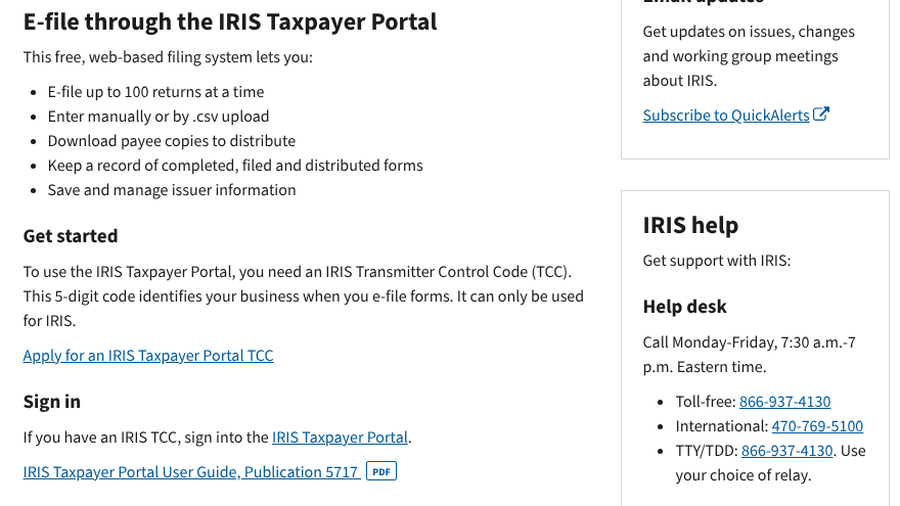
The IRIS Taxpayer Portal is the IRS’s own free, web-based filing system. You can e-file up to 100 returns at a time, type them in by hand or upload a CSV file. You can also download payee copies to give your contractors and keep a record of what you filed.
The catch is the setup. Before you can use the portal, you need an IRIS Transmitter Control Code, a five-digit code that identifies your business. You get it through an online application, and a TCC you used for FIRE won’t carry over. Apply this fall rather than the week before the deadline.
Timing is the other limit. IRIS opens for the new filing season in January, not before. When a tax preparer on Reddit asked in early January 2026 when it would open, another replied that it came online at 9:00 a.m. Eastern on January 6. That leaves a few weeks to file and deliver copies.
IRIS also leaves the chores to you. It won’t collect W-9s, verify tax ID numbers or mail copies to contractors. After you file, you download each payee copy and send it yourself, by mail or by email if the contractor has agreed to electronic delivery.
The CSV upload is the shortcut worth knowing. If your bookkeeping app can export contractor totals, you can match them to the IRS template once and reuse it each year. For a single-member LLC with two or three contractors, a little January admin is a fair trade for paying nothing.
- Pros: Free, filed directly with the IRS and it accepts CSV uploads.
- Cons: Requires a TCC application first, opens only in January and doesn’t deliver copies to recipients.
Pricing: Free.
2. TaxBandits
Best for: Owners who want the lowest per-form price from a paid service.
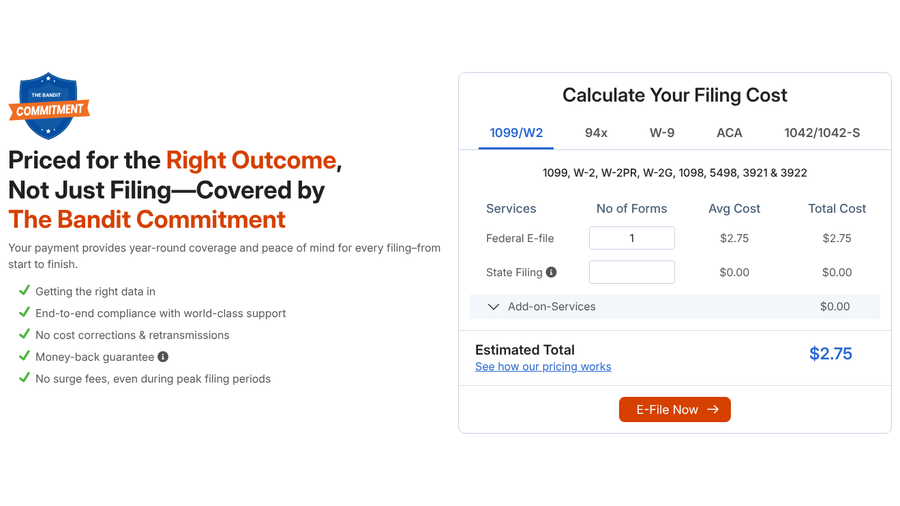
On TaxBandits’ pricing page, federal e-filing of Form 1099 costs $2.75 per form for your first 10 forms, dropping to $1.75 per form from 11 to 100. Three contractors cost $8.25 to file with the IRS. State filing alongside the federal return adds $0.95 per form.
The W-9 side is useful for new businesses. TaxBandits lets you request W-9s from contractors online, with the first five requests free and $0.35 per request after that. Collecting W-9s before you pay anyone is the habit that saves you in January. One Reddit commenter put it plainly: the real fix is getting the W-9 before the first payment.
Filers on Reddit have mostly described the 1099 side as smooth. In a January 2026 thread, one user said they chose TaxBandits for its straightforward pricing and bulk upload, and that its validation checks caught a couple of mistakes before the forms went to the IRS. The complaints we found mostly concerned payroll forms rather than 1099s.
Budget for add-ons, though. If your state requires its own 1099 filing, three forms with state filing come to $11.10. Mailing paper copies to contractors costs extra, so e-delivery with your contractors’ consent keeps the total down. A W-9/W-8 verification bundle, which checks a contractor’s tax ID against IRS records, costs $0.50 per recipient and is worth it when a W-9 looks off.
- Pros: Lowest paid price for small batches, free first W-9 requests and built-in error checks.
- Cons: State filing and postal mail are add-ons, and the pricing page covers many form types that can confuse first-timers.
Pricing: $2.75 per federal 1099 for the first 10 forms, then $1.75 per form up to 100. State filing adds $0.95 per form.
3. Tax1099
Best for: Businesses that want to upload a spreadsheet and pay only when they file.
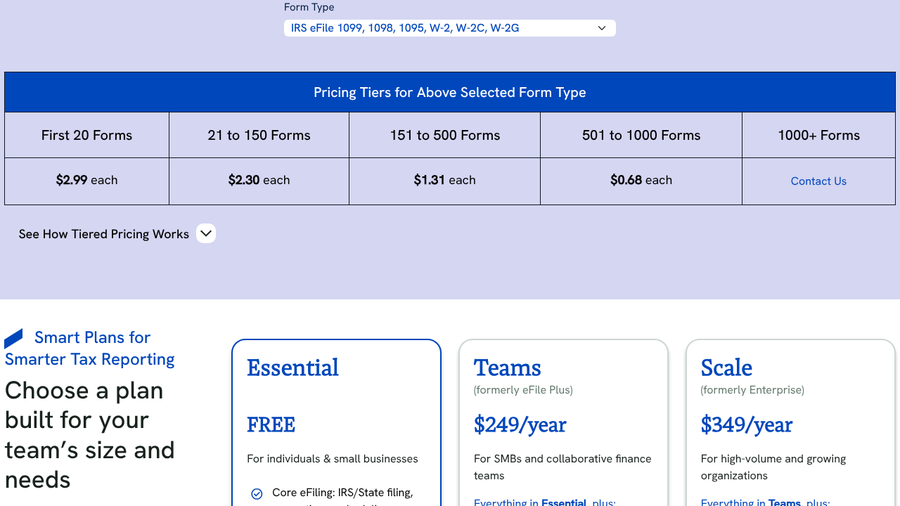
Zenwork’s Tax1099 pricing starts with a free Essential plan. You pay $2.99 per form for your first 20 IRS e-filings and $2.30 per form from 21 to 150, with no upfront fee. Paid Teams and Scale plans cost $249 and $349 a year and suit bookkeepers filing for many clients.
Tax1099 comes up again and again when small business owners ask Reddit which 1099 service to use. A tax preparer in a January 2026 thread said the Excel template upload made it simple. A sole proprietor filing for three contractors called it easy, cheap and subscription-free. One first-time user reported waiting about a week for IRS acceptance, and another said turnaround ran 7 to 10 days. That’s worth knowing if you file near the deadline.
The add-ons are priced separately. E-delivery to recipients costs $0.25 per form, and printing and mailing costs $1.90 per form. W-9 requests cost $1 for a single form or $7 for 25. Filing three forms with e-delivery comes to $9.72.
Tax ID checks come in two speeds. A real-time TIN match costs $1.00, while a match returned within 24 hours costs $0.37. If you’re checking a new contractor in December, the slower one is fine. Watch the calendar too, since Tax1099 adds a $1 rush fee to postal mail requests in the final five days of the filing season.
- Pros: No subscription, a template upload that handles bulk data and cheap e-delivery.
- Cons: W-9 requests aren’t free, and acceptance can take several days in peak season.
Pricing: $2.99 per form for the first 20 forms on the free Essential plan. E-delivery costs $0.25 per form and mailing $1.90 per form.
4. Avalara 1099 & W-9
Best for: Businesses that want contractor copies delivered by email without extra line items.
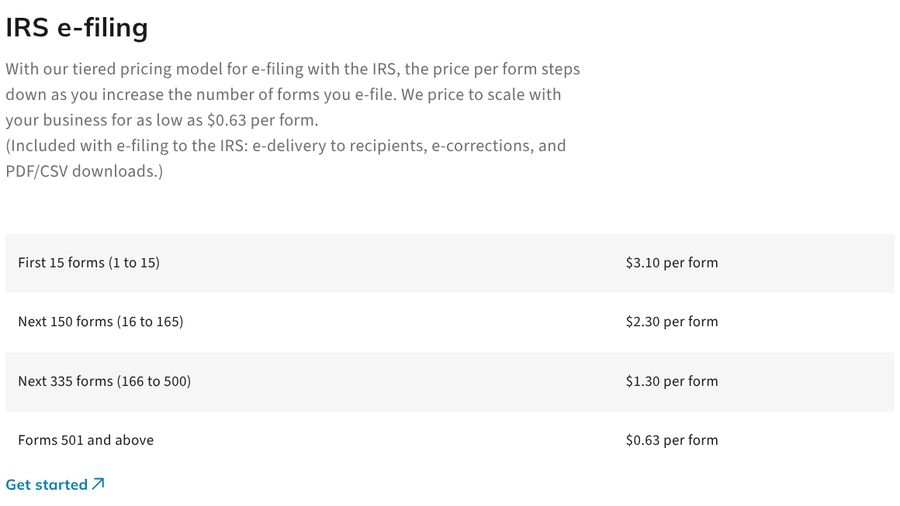
Avalara 1099 & W-9 used to be called Track1099, and the old track1099.com site now points to Avalara. According to Avalara’s 1099 pricing, IRS e-filing costs $3.10 per form for the first 15 forms and $2.30 per form for the next 150.
That’s the highest starting price here, but the bundle is different. The per-form fee includes e-delivery to recipients and e-corrections, so three contractors cost $9.30 with delivery handled. On Tax1099, the same three forms with e-delivery cost $9.72.
The optional extras are clearly priced. State e-filing costs $1.49 per form, and postal mail costs $1.84 per mailing through January 26. Mailing jumps to $2.89 from January 27 to 31, so a late start costs you. TIN matching against the IRS database is $0.45 per form, a sensible check if a contractor’s W-9 looks off.
Two policies are worth reading before you pay. Avalara says it e-files with the IRS each day at about 8 p.m. Pacific, and you can request a refund only until the e-filing or e-delivery goes out. Address validation costs $0.07 per form if you’re unsure where to mail a copy.
W-9 collection is sold as a separate plan. The Individual tier covers up to 25 W-9, W-8 and W-4 forms without TIN matching, and a free trial is available. Avalara also sells annual 1099 subscriptions starting at a 100-form tier, but for a new LLC, pay-as-you-go makes more sense.
- Pros: E-delivery and corrections included, clear add-on pricing and optional TIN matching.
- Cons: Highest per-form price for the first 15 forms, and late-January mailing costs more.
Pricing: $3.10 per form for the first 15 IRS e-filings, including e-delivery. State filing costs $1.49 per form.
5. QuickBooks Contractor Payments
Best for: Businesses that pay contractors every month and want the 1099s built from those payments.
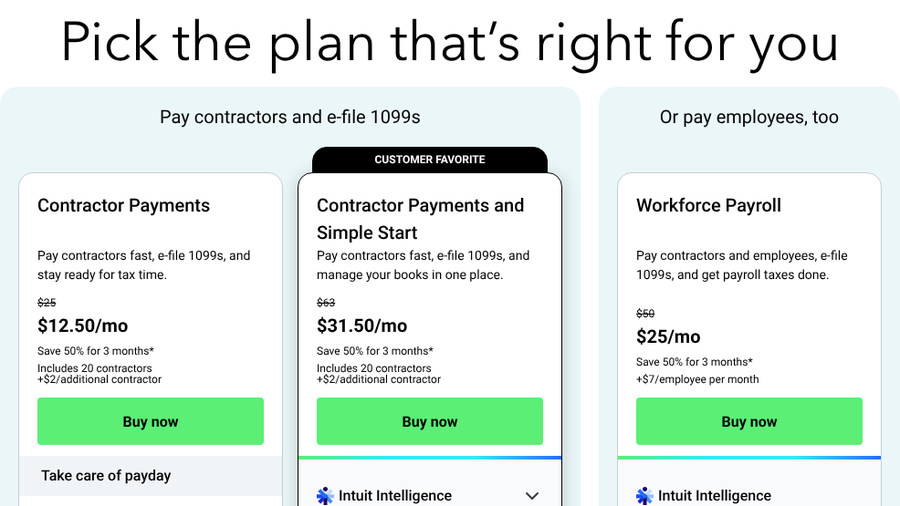
If you already pay contractors through QuickBooks, QuickBooks’ 1099 e-file page points you to Contractor Payments. It lists the plan at $25 a month with 20 contractors included and $2 for each additional contractor. It includes unlimited 1099 e-filing and next-day direct deposit to contractors. Contractors can set up their own accounts and complete W-9s online. The page also showed a 50% discount for the first three months when we checked in fall 2026.
The appeal is that the 1099 builds itself. Payments flow through the same system, you assign them to 1099 categories and the forms are ready to file in January. A paid Automated 1099s add-on can scan your books and fill in the forms for you.
The math only works if you use the payment side. At $25 a month, a full year costs $300, which is far more than filing three forms through TaxBandits or Tax1099. It’s worth it when you pay contractors often and want W-9s, payments and filings in one place.
Two bigger plans include the same 1099 filing. A bundle with QuickBooks Simple Start for bookkeeping was listed at $63 a month before the discount. Workforce Payroll, for businesses that also pay employees, was listed at $50 a month plus $7 per employee. If you already run your books in QuickBooks Online, the bundle saves you from exporting contractor totals to a separate filing service each January.
- Pros: Unlimited 1099 e-filing, contractor self-setup for W-9s and next-day direct deposit.
- Cons: A monthly fee for a yearly task, and the automated 1099 feature costs extra.
Pricing: $25 per month with 20 contractors included, then $2 per additional contractor.
6. Gusto Contractor Only
Best for: Contractor-only businesses that expect to hire W-2 employees.
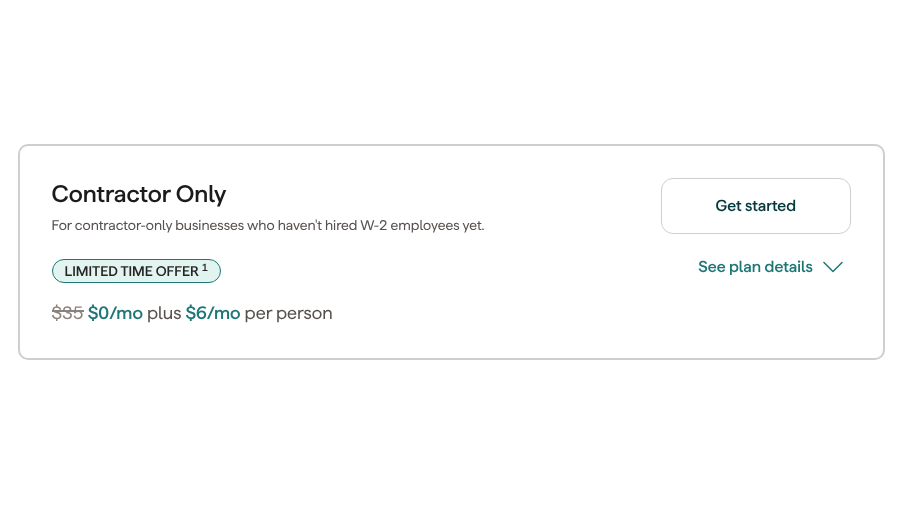
Gusto’s Contractor Only plan is built for businesses that haven’t hired W-2 employees yet. Gusto’s pricing page lists it at $35 a month plus $6 per contractor, and a limited-time offer was waiving the base fee when we checked in fall 2026. Gusto says it bills for contractors only in months when you pay them, which helps if your freelancers work in bursts.
The plan covers domestic contractor payments and Form 1099 creation and filing. Paying global contractors carries no monthly per-contractor fee, only a service and exchange fee for each payment.
The main reason to pick Gusto over QuickBooks is what comes next. When you hire your first employee, you move up to a payroll plan in the same account instead of switching providers mid-year. Gusto’s payroll plans start at $49 a month for single-state payroll.
Run the numbers before you sign up. Two contractors paid every month cost $47 a month at full price, or $564 a year, against $300 a year for QuickBooks Contractor Payments with up to 20 contractors. For a business that pays two contractors once a year, Gusto is overkill. It earns its fee when the first employee hire is months away rather than years. Gusto’s pricing page also promises no contracts and free account setup, so you can cancel after filing season if the math stops working.
- Pros: Contractor payments and 1099 filing together, billing only in months you pay contractors and a clear path to payroll.
- Cons: The per-contractor fee adds up for larger teams, and it’s too much for occasional contractor payments.
Pricing: $35 per month plus $6 per contractor in months you pay them. The base fee was discounted under a limited-time offer in fall 2026.
How We Chose These
We focused on ways a small business or new LLC can e-file Form 1099-NEC for 2026 payments without an accountant. We compared the cost of filing a handful of forms and what each option handles beyond filing, from W-9 collection to recipient delivery. We checked pricing pages in fall 2026 against IRS guidance and read small business owners’ and tax preparers’ accounts of what worked.
This article is general information, not tax, accounting or legal advice. Reporting thresholds, forms and deadlines change, and your situation may differ. Confirm current requirements at IRS.gov and talk to a tax professional about your business’s obligations.
The Bottom Line
If you’re filing a few 1099s and can apply for a TCC this fall, IRIS costs nothing. To skip the setup, TaxBandits and Tax1099 file three forms for under $10, and Avalara bundles e-delivery for a little more. Choose QuickBooks or Gusto only if you’ll pay contractors through them all year. Either way, collect W-9s now and file by February 1, 2027. If you’re on the receiving end of 1099s, our guide to TurboTax alternatives for gig workers covers filing your own return.
Frequently Asked Questions
What is the best way to file 1099s online?
For a few forms, the free IRS IRIS Taxpayer Portal is cheapest if you apply for a TCC in advance. For W-9 collection and recipient delivery, TaxBandits, Tax1099 and Avalara charge about $3 per form or less.
Can I file 1099s online for free?
Yes. The IRS IRIS Taxpayer Portal is free for up to 100 returns at a time. You need an IRIS Transmitter Control Code first, and you deliver contractor copies yourself.
What is the 1099-NEC threshold for 2026?
For payments made in 2026, the reporting threshold for Forms 1099-NEC and 1099-MISC is generally $2,000, up from $600. The IRS can index it to inflation from 2027.
When are 1099-NEC forms due in 2027?
Form 1099-NEC is normally due January 31, which falls on a Sunday in 2027. Forms for 2026 payments are due to the IRS and to contractors on Monday, February 1, 2027.
Can I still file 1099s through the IRS FIRE system?
No. The IRS says the last day to file through FIRE is November 19, 2026, so tax year 2026 returns must go through IRIS or software that connects to it.