
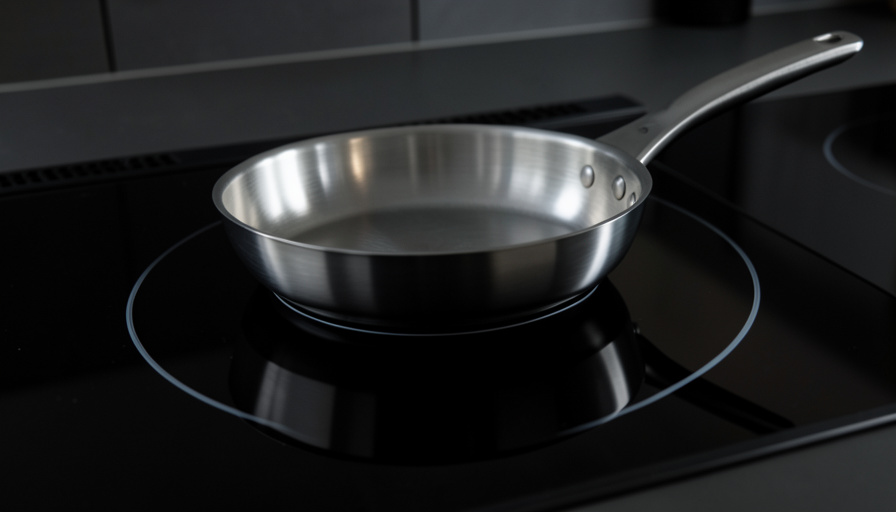
You set a pan on the induction cooktop, the zone lights up, you dial in the heat, and a few seconds later it clicks off as if you never turned it on. Swap in a different pan and it works fine. It is a maddening pattern, and it makes the cooktop feel broken, but in almost every case it is not. Induction only heats a pan it can detect, and when it cannot detect one reliably, it shuts the zone off on purpose. So “shuts off with certain pans” is usually the cooktop telling you those particular pans are the problem, not the appliance.
Here is why it happens, the specific causes to check, and how to fix each one so the zone stays on.
The short answer
An induction cooktop shuts off with certain pans because it cannot sense a compatible pan on the zone, and pan detection is a safety feature that powers the zone down when it does not find one. The usual causes are a pan that is not magnetic enough, a pan too small for the zone’s minimum detection size, a warped or uneven pan bottom that does not sit flat, or a pan set off-center. Less often, it is the cooktop’s overheating cutoff after long high heat or with blocked vents. The fixes are practical: use flat-bottomed magnetic cookware sized to the zone, confirm each pan with a fridge-magnet test, center the pan, keep the base and cooktop clean and the vents clear, or use an induction interface disk for small or non-magnetic pans. If a known-good pan still triggers a shutoff or an error code, the cooktop itself may need service.
Table of Contents
Why an induction cooktop shuts off with certain pans
Induction heats by creating a magnetic field that induces current in a compatible pan, so the cooktop first checks that a suitable pan is present. If it senses one, the zone runs; if it does not, it powers the zone off rather than pushing energy into nothing, which would be wasteful and unsafe. That is the whole mechanism behind the mystery. When a pan works on one zone and not another, or works intermittently, the detection is succeeding sometimes and failing other times. So the fix is almost always about giving the cooktop a pan it can detect cleanly and steadily, and the causes below are the reasons detection fails.
1. The pan is not magnetic enough
This is the most common cause. Induction needs ferrous, magnetic cookware, and a pan made of aluminum, copper, glass, or non-magnetic stainless steel will not be detected, so the zone shuts off. Some pans are partly magnetic, with a thin or incomplete magnetic layer, and those can be detected weakly or inconsistently, which produces the on-then-off behavior. The test is simple: hold a fridge magnet to the bottom of the pan, and if it grips firmly, the pan will work. Whirlpool’s guide to induction cookware covers the magnet test and which materials qualify. If the magnet barely sticks or slides off, that pan is the problem.
2. The pan is too small for the zone
Each cooking zone has a minimum pan size it can detect, and a pan whose base is smaller than that threshold may not register, so the zone cuts out. A small saucepan or milk pan on a large zone is a classic trigger, and it can be intermittent, working when centered perfectly and dropping out when nudged. The fix is to match the pan to the zone: use a small zone for a small pan, or a pan whose base covers enough of the zone to be detected. If you often cook with small pots, choosing a cooktop with a smaller zone, or using an interface disk, solves it.
3. The pan bottom is warped or uneven
Induction wants full, flat contact with the glass. A pan with a warped, convex, or dented bottom rocks or sits with a gap, so the cooktop only makes partial contact and detection flickers, cutting the zone off and on. Older pans and thin ones that have overheated are prone to this. Set the suspect pan on a flat counter and check whether it wobbles or spins; if it does, its base is no longer flat. A flat-bottomed pan of good weight sits solidly and is detected steadily, so replacing a warped pan usually clears the shutoffs it caused.
4. The pan is not centered on the zone
Detection works best when the pan sits centered over the zone’s marked ring. A pan pushed to the edge, or straddling two zones, gives the sensor a poor read and can cause the zone to power down. This one is easy to miss because the pan looks close enough. Line the pan up with the printed circle so it covers the zone evenly, and keep it there rather than sliding it around during cooking, since moving a pan off the zone can also trigger the auto shut-off that pauses heat when no pan is sensed.
5. It is an overheating safety cutoff
Sometimes the pan is fine and the cooktop is protecting itself. Induction units have thermal cutoffs that power a zone, or the whole cooktop, off if it gets too hot, which can happen during long stretches at high heat, with a dry or empty pan, or when the cooktop’s vents are blocked so it cannot cool. If shutoffs happen mainly after extended high-heat cooking rather than with specific pans, this is the likely cause. Give the cooktop room to breathe by keeping the vents clear, avoid running an empty pan on high, and let it cool before resuming. Normal cooking resumes once the temperature drops.
How to fix it step by step
Work through it in order. First, run the magnet test on the pans that fail, and set aside any the magnet will not grip. Next, match each pan to an appropriately sized zone and center it on the marked ring. Check the base of any problem pan for flatness on a level counter, and retire warped ones. Wipe both the pan base and the cooktop glass, since grit or a film can interfere with contact. Make sure nothing is blocking the cooktop’s ventilation, and let the unit cool if you have been cooking hot for a long time. For small pots or a favorite non-magnetic pan you do not want to give up, an induction interface disk, a magnetic plate that sits between the pan and the glass, lets the zone detect and heat it. Finally, if a pan you have confirmed is compatible, flat, and correctly sized still triggers a shutoff or an error message, power the cooktop off at the breaker for a minute to reset it, and if the problem continues, the cooktop likely needs a technician. If you are still deciding whether induction suits your kitchen, our induction versus gas range statistics guide covers the wider trade-offs.
This article is general troubleshooting information, not professional repair advice. Induction cooktops and their error codes vary by brand and model, so check your unit’s manual for its specific requirements, and if a compatible, flat, correctly sized pan still causes shutoffs or the cooktop shows a persistent error, contact the manufacturer or a qualified appliance technician.
Frequently asked questions
Why does my induction cooktop turn on then shut off by itself?
Because it cannot reliably detect a compatible pan on the zone, so it powers off as a safety measure. The pan may not be magnetic enough, may be too small for the zone, may have a warped bottom that does not sit flat, or may be off-center. Occasionally it is an overheating cutoff after long high heat or with blocked vents. Using a flat, magnetic pan sized to the zone and centered on it usually stops the shutoffs.
How do I know if a pan will work on my induction cooktop?
Hold a fridge magnet to the bottom of the pan. If it grips firmly, the pan has enough magnetic material to be detected and heated. If it does not stick or only sticks weakly, the pan is not fully induction compatible and may cause the zone to cut out. Cast iron and much stainless steel pass, while aluminum, copper, glass, and non-magnetic stainless generally do not.
Can I use a small pan on an induction cooktop?
Only if its base meets the zone’s minimum detection size. A pan too small for the zone may not register, so the zone shuts off. Use a smaller zone for a small pan, or place an induction interface disk, a magnetic plate, under the small pan so the cooktop detects the disk and heats it. Matching pan size to zone size is the reliable fix.
What is an induction interface disk?
It is a flat magnetic plate you set on the zone with your pan on top. The cooktop detects and heats the disk, which then heats the pan by contact, letting you use small pans or non-magnetic cookware that the cooktop could not otherwise detect. It is a handy workaround, though it is less efficient than a directly compatible pan, so it is best for occasional use rather than everyday cooking.
My cooktop shuts off even with a good pan. What now?
If a pan you have confirmed is magnetic, flat, and sized to the zone still triggers shutoffs, first reset the cooktop by switching it off at the breaker for a minute, and make sure the vents are clear and the unit has cooled. Check the manual for any error code shown. If the problem persists with known-good cookware, the fault is likely in the cooktop rather than the pan, and it should be inspected by the manufacturer or a qualified technician.
The bottom line
An induction cooktop that shuts off with certain pans is usually doing its job: it cannot detect those pans well enough to heat them safely, so it powers the zone down. Run the magnet test, match each pan to the right zone and center it, retire warped bases, keep the glass and vents clean and clear, and reach for an interface disk when you need to use a small or non-magnetic pan. Work through those and the zone should stay on, and only when a genuinely compatible pan keeps failing is it time to call for service. Start with the pan, not the cooktop, and most of these shutoffs solve themselves. For more kitchen fixes, browse The Other Stream’s Home Improve section.