
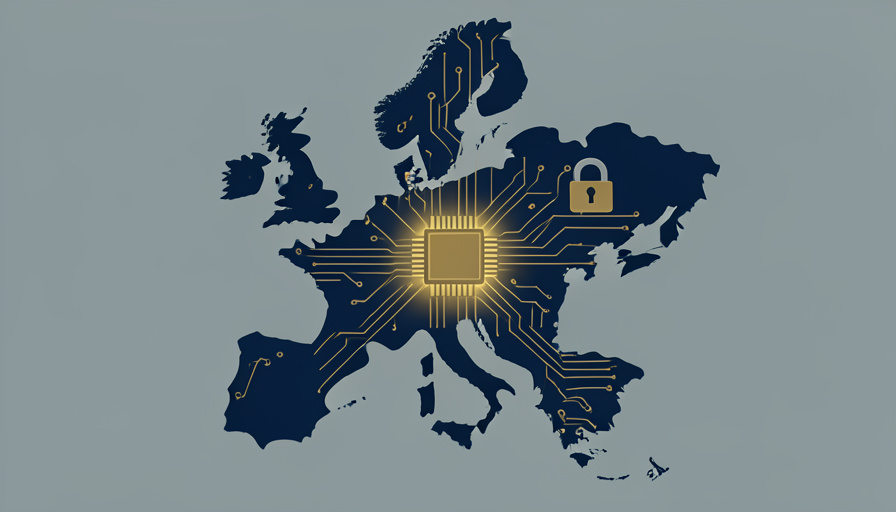
Europe just placed its largest single bet on building an AI industry it actually controls. The number is impressive. The strategy behind it runs into a harder truth: the continent can fund a champion far more easily than it can make the chips that champion runs on.
When Mistral closed a €3 billion Series D in September 2026, the coverage framed it as a milestone for European technology, and it is. It is the largest equity round a European tech company has ever raised. But the more useful question is not how big the round was. It is whether pouring billions into one lab actually moves Europe closer to the “sovereign AI” its leaders keep promising. The answer is a qualified yes, with a large asterisk shaped like a semiconductor.
The Short Version
Mistral’s €3 billion round gives Europe a credibly funded, homegrown AI lab and strengthens the political case for “sovereign AI,” meaning models and data that stay under European control. But AI independence depends on chips and cloud infrastructure as much as on who owns the model, and Europe produces roughly 10% of the world’s semiconductors while relying almost entirely on American and Asian suppliers for the advanced ones. Money buys a champion. It does not quickly buy a supply chain. Mistral makes Europe’s AI ambition more real without resolving the dependency underneath it.
Table of Contents
What “sovereign AI” actually means in Europe’s plan
Sovereign AI is shorthand for keeping the important parts of the AI stack, the models, the training data, and the infrastructure that runs them, inside European jurisdiction and out of the reach of foreign governments or a single vendor’s terms. Brussels has been explicit about the fear driving it. As one European official put it while unveiling the bloc’s tech sovereignty package, “we want to be sure nobody has a kill switch,” CNBC reported.
Mistral fits neatly into that story. It is French, it offers EU data residency, and several of its models ship as open weights you can run on your own hardware. For politicians selling AI independence, a well-funded French lab is a far better poster child than another contract with a U.S. cloud provider. That symbolic value is real, and the funding round amplifies it.
The chip problem money can’t buy its way out of
Here is where the strategy gets uncomfortable. A model is only sovereign if the hardware training and serving it is available on European terms, and that is precisely where Europe is weakest.

The EU produces around 10% of the world’s semiconductors and depends almost entirely on the United States and East Asia for the most advanced ones, the exact chips modern AI training needs. Brussels knows this, which is why its 2026 tech sovereignty package leans on a sequel to the 2023 Chips Act to boost local fabrication, as Fortune detailed. But fabs take years and tens of billions to build. Mistral’s €3 billion, large as it is, does nothing to change which company’s chips sit in the racks doing the actual work. A European model trained on American silicon is more independent than nothing, though it is not the clean sovereignty the branding implies.
The paradox inside the raise
There is a second wrinkle worth naming. The round meant to advance European independence was led by Samsung, a Korean conglomerate, and included American asset managers among the investors. A sovereign champion with a capital table spanning three continents is a slightly awkward flag to wave. This does not undermine Mistral’s technology or its EU data guarantees, which are technical facts rather than marketing. But anyone treating the raise as a story of Europe funding its own future should notice that a good chunk of the money came from outside Europe.
What the €3 billion actually changes
Set the caveats aside for a moment, because the round does shift things. Three changes matter. Mistral now has the capital to keep training competitive models rather than falling behind on compute, which keeps a European option on the table at all. Its EU data-residency and self-hosting products give regulated European organizations a legitimate alternative to sending everything to U.S. clouds. And politically, a marquee raise gives momentum to the wider sovereignty agenda, including the Cloud and AI Development Act aimed at loosening U.S. hyperscaler dominance in the EU market.
None of that is nothing. A continent that wants options first needs a vendor worth choosing, and Mistral is now more firmly that vendor.
What to watch next
The honest test of Europe’s AI-independence strategy will not be funding announcements. Watch these instead:
- Whether the EU Chips Act sequel actually raises local advanced-chip capacity, or stalls like earlier efforts.
- Whether large European enterprises move real workloads to Mistral and European clouds, rather than treating them as a compliance backup.
- Whether Mistral keeps pace with the frontier labs on model quality now that it has the compute budget.
- How the Cloud and AI Development Act is enforced, and whether it changes hyperscaler market share in practice.
This article is general information about industry and policy trends, not investment or business advice. Verify current details before making decisions that depend on them.
What To Know
- Mistral’s €3 billion round is Europe’s biggest single bet on homegrown AI and strengthens the sovereign-AI case.
- True independence also needs chips and cloud, where Europe remains heavily dependent on the U.S. and Asia.
- The EU makes roughly 10% of the world’s semiconductors, so the hardware gap is a years-long problem.
- The round was led by Samsung and included U.S. investors, complicating the “European independence” framing.
- The real test is chip capacity and whether enterprises actually switch, not funding headlines.
Frequently Asked Questions
What does “sovereign AI” mean for Europe?
It means keeping the key parts of the AI stack, models, training data, and the infrastructure that runs them, under European control and jurisdiction, so that no foreign government or single vendor can cut off access. Data residency and open, self-hostable models are central to the idea.
Does Mistral’s funding make Europe independent in AI?
Partly. It gives Europe a well-funded domestic lab and a credible alternative to U.S. providers, but independence also depends on chips and cloud infrastructure. Europe still relies heavily on American and Asian suppliers for advanced semiconductors, which funding a model company does not fix.
Why are semiconductors a problem for European AI sovereignty?
Advanced AI training runs on the latest chips, and the EU produces only about 10% of the world’s semiconductors while depending on the U.S. and East Asia for the most advanced ones. Building domestic fabrication takes years and huge investment, so the dependency persists regardless of model funding.
Is Mistral really European if foreign investors funded it?
Mistral is a French company offering EU data residency, but its September 2026 round was led by Samsung and included U.S. investors. The technology and data guarantees are European; the ownership is international, which is why “sovereign” describes where data is processed more than who funds the company.
What is the EU doing to reduce tech dependence?
The EU introduced a 2026 tech sovereignty package that includes a sequel to its 2023 Chips Act to boost local semiconductor production, plus a Cloud and AI Development Act aimed at reducing reliance on U.S. hyperscalers. Results will take years to appear.
The Bottom Line
Mistral’s €3 billion is a genuine milestone, and it makes Europe’s AI ambitions more than a slide in a policy deck. The catch is that independence is a stack, not a single company, and the layers Europe controls least, advanced chips and cloud scale, are the ones money moves slowest. Funding a champion was the easy part. The strategy only pays off if the harder pieces follow. For more on the AI market and policy, browse The Other Stream’s Business section, or our Tech coverage.