
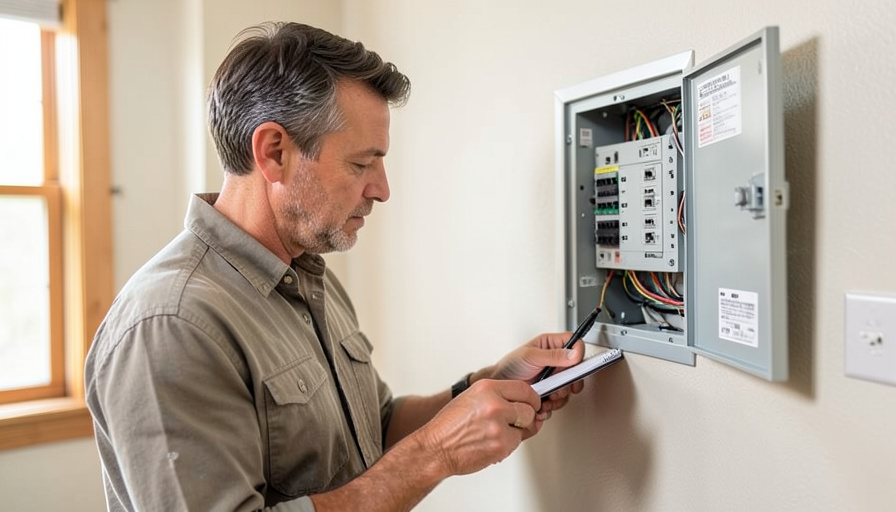
You want to add an EV charger, or a heat pump, or just stop tripping breakers, and someone mentioned you might need to upgrade to a 200-amp panel. That is a real, permitted, several-thousand-dollar job, so it is worth understanding roughly what your home draws before you commit, or before an electrician quotes you. You cannot do the official work yourself, but you can walk through the same inputs a professional uses and get a feel for whether an upgrade is actually necessary.
What follows is an educational walk-through of the checks behind a residential load calculation, not a do-it-yourself electrical guide. Please read the safety note below before you touch anything, because the point here is to inform your conversation with a licensed electrician, not to replace it.
Safety first: This article is general information, not electrical or code advice, and it is not a substitute for a professional load calculation. Electrical work is dangerous and, for a panel or service upgrade, legally requires a licensed electrician and a permit in most places. The figures below are rough rules of thumb that vary by the National Electrical Code edition and your local code. Do not open, modify, or work on your panel yourself. Use these checks only to understand your situation before hiring a licensed pro.
Key takeaways
A load calculation adds up your home’s electrical demand to see whether your service, commonly 100, 125, or 200 amps, can carry it. The big drivers are heating and cooling, an electric range, dryer, water heater, and increasingly an EV charger, which alone can push a marginal panel over the edge. General lighting is estimated from square footage, and code applies demand factors so you do not simply add every nameplate watt. Sometimes the honest answer is that 100 or 125 amps is still enough, or that smart load management avoids an upgrade entirely. A licensed electrician must run the official calculation and pull the permit, but understanding these inputs helps you ask the right questions.
Table of Contents
1. Read your panel’s current amperage rating
Start by knowing what you have. The main breaker at the top of your panel is stamped with its rating, often 100, 125, 150, or 200 amps, and that number is your service size. Many homes labeled as needing an upgrade already have 100 or 125 amps, which can be plenty depending on the loads. You can read this rating by looking at the breaker without opening or touching anything inside the panel. Knowing your starting point tells you how much headroom you are actually working with.
2. Understand the standard vs. optional calculation method
Electricians can calculate residential load two ways under the code: a detailed standard method and a simpler optional method for dwellings. The optional method applies a generous demand factor to most of your load after the first chunk, which is why your home does not need a service equal to every appliance running at once. Understanding that demand factors exist is the key insight, because it explains why adding up nameplate wattages overestimates what you need. The exact factors and thresholds are what your electrician applies precisely.
3. Estimate general lighting from square footage
The code estimates your general lighting and receptacle load from floor area rather than counting every outlet, using a set figure per square foot of living space. It is a baseline that scales with house size, so a larger home carries a larger general load before any appliances are added. You can approximate this from your home’s square footage. It is usually a modest slice of the total compared with the big appliances, but it is where a proper calculation begins.
4. Add the fixed small-appliance and laundry circuits
On top of general lighting, the calculation adds standard amounts for the required kitchen small-appliance circuits and the laundry circuit, each a fixed figure defined by code. These are counted whether or not everything is plugged in, because the circuits exist and could be loaded. They are predictable additions that every home includes. Knowing they are part of the base helps explain why even a modest home starts with a meaningful baseline load before the heavy hitters.
5. Account for heating and cooling
Heating and cooling are usually the largest single loads, and the calculation counts the larger of your heating or air-conditioning demand rather than both, since you rarely run them at once. A central AC compressor or a heat pump draws heavily, and electric resistance heat draws even more. If you are adding a heat pump or a larger AC, this is often the number that changes the whole picture. Get the nameplate ratings of your HVAC equipment, because this line frequently drives the result.
6. Include the electric range and oven
An electric range or wall oven is a large fixed load, though the code applies a demand factor so a big range does not count at its full nameplate rating. Still, it is one of the heavier appliances in the calculation. If your kitchen is electric rather than gas, this is a significant contributor. Note whether you have, or plan to add, an electric cooking appliance, since switching from gas to electric cooking meaningfully raises your demand.
7. Count the electric clothes dryer
An electric dryer adds a substantial fixed load, with the code specifying a minimum figure regardless of the exact model. Like the range, it is counted as one of the defined appliance loads. A gas dryer, by contrast, barely registers electrically. If you run an electric dryer, or would after a change, include it, because it is one of the standard large appliances a load calculation always weighs.
8. Add the electric water heater
A conventional electric water heater is a large continuous load, typically several kilowatts, and it counts in the calculation as one of your major appliances. Tankless electric water heaters can draw even more at once and deserve special attention. A gas water heater adds little electrically. If your hot water is electric, this is another significant line, and moving from gas to electric water heating adds noticeably to your total.
9. Give the EV charger special weight
A Level 2 EV charger is the load that pushes many homes toward an upgrade. A charger can draw a large, sustained current, and because it runs for hours it is treated as a continuous load, which code counts at 125 percent of its rating. A 48-amp charger is a serious addition to a panel that was sized before EVs existed. If an EV charger is your reason for asking about 200 amps, this is likely the deciding factor, and it is worth discussing load-managing chargers that can reduce the impact.
10. Include pools, spas, wells, and other big motors
Beyond the standard appliances, add any other large loads unique to your home: a pool pump, a hot tub or spa, a well pump, a workshop, or other sizable motors. These are easy to forget and can be significant, especially a spa or pool equipment. Make a list of every major powered feature of your property. A calculation is only as accurate as the loads it includes, so leaving out the hot tub can make an upgrade look unnecessary when it is not.
11. Weigh future headroom against a real need
Finally, think ahead, but honestly. It is reasonable to size for plans you will actually carry out, an EV, a heat pump, an addition, so you are not upgrading twice. But it is just as common to discover that your current 100 or 125 amps genuinely suffices, or that a subpanel or a smart load-management device solves the problem for far less than a full service upgrade. The right answer is whatever the real numbers show, not automatically the biggest panel available.
What to do with these numbers
Use these checks to understand your situation, then hand the real work to a professional. Total up your major loads to get a rough sense of whether you are close to your service limit, but remember that the code’s demand factors, the exact method, and your local rules determine the official result, which a licensed electrician calculates and stamps. They will also tell you whether a full 200-amp upgrade is warranted or whether a subpanel, a load-management device, or a smart EV charger achieves your goal for less. Reference material like the National Fire Protection Association, which publishes the National Electrical Code, underlies all of this, but interpreting it for your home is a licensed professional’s job. For another home upgrade worth doing carefully, see our checklist on renter-safe smart lock installs.
This article is general information, not electrical, code, or safety advice, and not a substitute for a professional load calculation. Panel and service upgrades legally require a licensed electrician and a permit in most jurisdictions, and requirements vary by code edition and locality. Do not perform electrical work yourself; consult a licensed electrician for any calculation or upgrade.
Frequently asked questions
Do I really need a 200-amp panel?
Not always. Many homes run fine on 100 or 125 amps, and the answer depends on your actual loads, especially heating and cooling, electric cooking, and an EV charger. A proper load calculation, run by a licensed electrician, is the only way to know. Sometimes a subpanel or load-management device avoids a full upgrade.
Can I do my own electrical load calculation?
You can estimate your loads to understand your situation, but you cannot perform the official calculation or the upgrade yourself. The code applies specific methods and demand factors, and a panel or service upgrade legally requires a licensed electrician and a permit in most places. Use these checks to inform your conversation, not replace it.
Why does an EV charger matter so much for panel size?
Because a Level 2 charger draws a large current for hours, it counts as a continuous load at 125 percent of its rating, and a 48-amp charger is a major addition to an older panel. It is the most common reason homeowners ask about 200 amps. A load-managing charger can sometimes reduce the impact enough to avoid an upgrade.
Is 100-amp service enough for a modern home?
It can be, depending on your loads. A home with gas heat, cooking, and hot water and no EV charger may sit comfortably within 100 amps, while an all-electric home with an EV likely needs more. Only a professional load calculation for your specific home can answer it reliably.
What are demand factors in a load calculation?
They are code allowances that count large loads at less than their full nameplate rating, because you rarely run everything at once. This is why simply adding up every appliance’s wattage overestimates what your service needs. The exact factors depend on the calculation method your electrician uses and the code in force.
The bottom line
Before paying for a 200-amp upgrade, it pays to understand what your home actually draws: your current service size, your heating and cooling, the big electric appliances, and above all an EV charger, tempered by the code’s demand factors. Sometimes the numbers justify the upgrade, and sometimes a subpanel or smart load management does the job for less. Either way, a licensed electrician runs the official calculation and pulls the permit. For more on maintaining and improving your home safely, browse The Other Stream’s Home Improve section.