
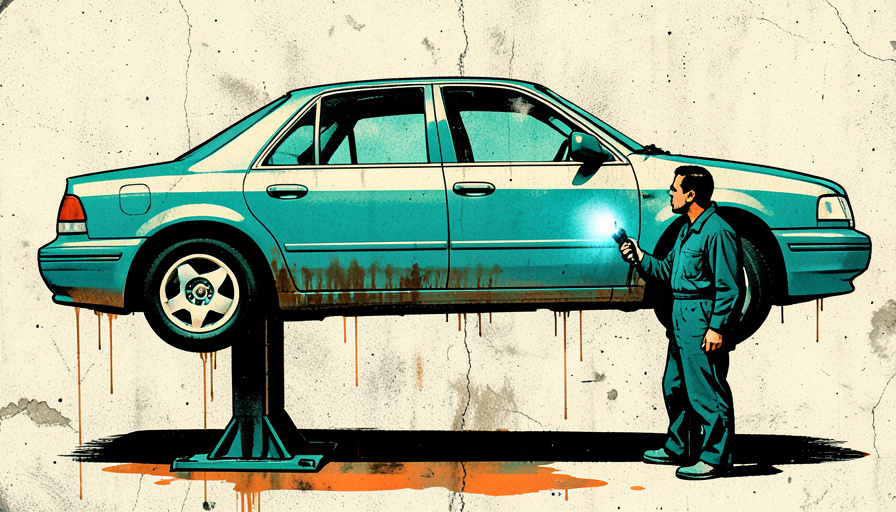
Five pre-purchase inspection services for private-sale buyers, what each costs in 2026 and what to ask the inspector to check when you’re worried about flood damage or a washed title.
In August 2026, a buyer in Pennsylvania posted on Reddit about a car they’d bought from a private seller on Facebook Marketplace. The seller had mentioned a broken muffler and normal wear. On the drive home, the transmission acted up, and later the buyer found heavy rust, plus a hole in the carpet with more rust hidden under a floor mat. The seller went quiet for a week. Commenters were blunt: a private sale is usually as-is, and a mechanic’s look before paying would have been “well worth the $100 or whatever.” A pre-purchase inspection is the step that catches what a history report and a friendly seller won’t tell you.
The best pre-purchase inspection services for private-sale buyers in 2026 are:
- iNeedaPPi: best for same-day inspections with extra VIN checks
- POMCAR: best budget option for a nationwide mobile inspection
- Lemon Squad: best for EVs, classics and other specialty vehicles
- A RepairPal Certified shop: best for a lift inspection near the car
- YourMechanic: best for booking a vetted mobile mechanic by profile
Quick Picks
| Option | Best For | Where It Happens | Price | Flood and Title Checks |
|---|---|---|---|---|
| iNeedaPPi | Same-day in covered cities | At the car | $189.99 | VIN in 3 places plus computer VIN, water intrusion |
| POMCAR | Budget nationwide | At the car | $180 to $195 | VIN on dash, doors, hood and trunk |
| Lemon Squad | Specialty vehicles | At the car | From $210 | Previous flood damage on every package |
| RepairPal Certified shop | Lift access | At a shop | $186 to $273 average | Depends on what you request |
| YourMechanic | Choosing your mechanic | At the car | Quote by ZIP and car | 150-point check, no lift |
Table of Contents
Why a clean history report isn’t enough
Flood cars travel. In an August 2026 warning, the National Insurance Crime Bureau (NICB) said flood-damaged vehicles often reenter the used market hundreds of miles from where the flooding happened, frequently without proper disclosure. A totaled flood car should carry a salvage or flood title, but NICB says dishonest sellers hide that history with surface repairs and “title washing,” which means retitling the car somewhere its damage brand doesn’t carry over. It cited a Carfax estimate that as many as 530,000 flood-damaged vehicles were on U.S. roads as of August 2025.

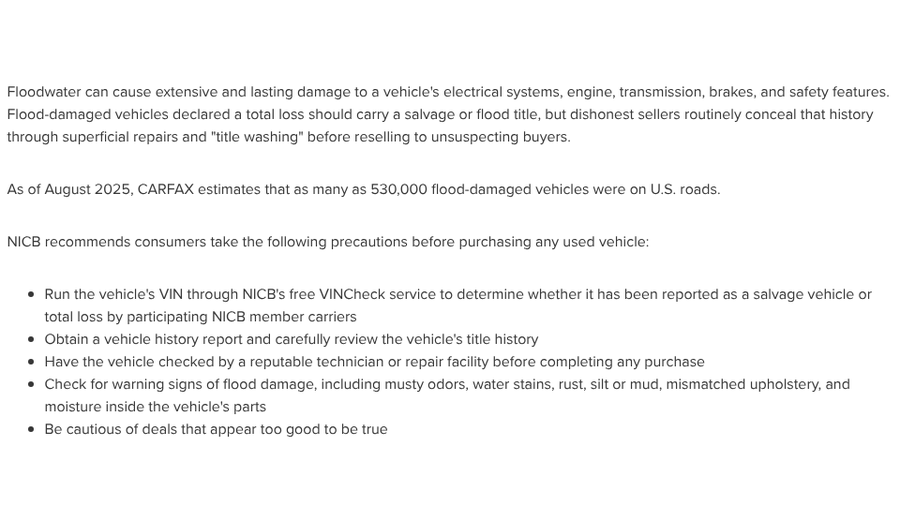
Paperwork can look perfect. In May 2026, a Washington driver told Reddit they’d bought a car on Facebook Marketplace in 2022 with a clean title in the seller’s name. They registered and insured it with no problems. Years later, a free VIN report showed a salvage brand from Oregon. That is why NICB’s checklist includes both a history report and having the vehicle checked by a reputable technician before you buy. Start with a report from our list of Carfax alternatives for flood and salvage checks, then book one of the inspections below.
1. iNeedaPPi
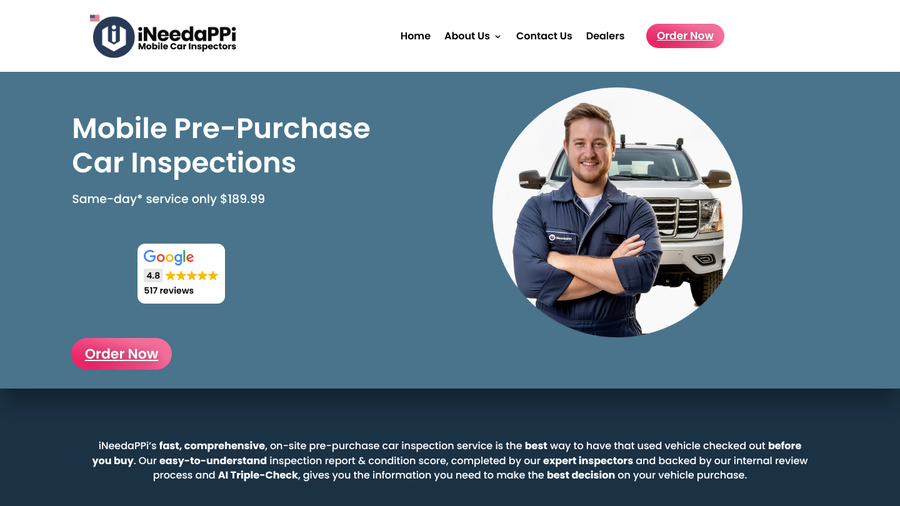
Best for: Buyers in covered cities who want a fast inspection with extra VIN verification.
iNeedaPPi is a mobile inspection outfit built around speed. You order online, share the private seller’s contact details and pay $189.99. It then schedules with the seller and aims to inspect the car the same day whenever possible. The report and condition score arrive by email about an hour after the inspection ends.
For title-wash worries, the VIN checks stand out. iNeedaPPi says its inspectors record the VIN from three different places on the body and verify the internal VIN while scanning the onboard computer for fault codes. A VIN that doesn’t match across the dash, the body and the computer is a reason to walk away before you ever get to the title. Inside, inspectors check the seats, carpet, trunk and headliner. They look for stains, odors and signs of water intrusion.
The report is detailed. It includes 50-plus photos and videos, a full engine start-up and walkaround video, a full undercarriage video and a condition score out of 100. You also get a list of recommended repairs with urgency and estimated costs, which helps when you negotiate. Add-ons include a Carfax report for $20 and a market price appraisal for $20.
Coverage is the catch. Its city list leans on Florida and Texas, with Miami, Tampa and Orlando alongside Houston and Dallas. Phoenix, Portland and Shreveport are listed too, and a location checker covers other areas in the U.S. and Canada. Several of those are markets where flooded cars turn up after storms, which makes it a strong fit there. Outside its cities, you’ll need another option. As with any mobile inspection, the underside check happens where the car is parked rather than on a shop lift.
- Pros: Same-day scheduling when possible, VIN checked in three body locations and the computer, and a report about an hour after the visit.
- Cons: Limited list of cities, and no shop lift for the underbody check.
Pricing: $189.99 per inspection, plus $20 each for an optional Carfax report or market price appraisal.
2. POMCAR
Best for: Budget-minded buyers who need a mobile inspection almost anywhere in the U.S.
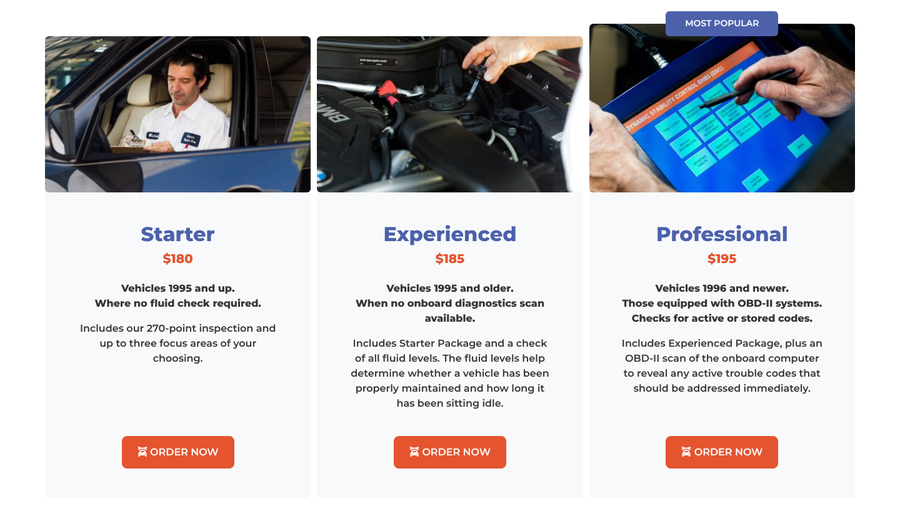
POMCAR sends vetted technicians to inspect cars, trucks, SUVs and light commercial vehicles nationwide. Every package includes a 270-point inspection and a road test, provided the vehicle is roadworthy and the seller allows it. You can also name up to three focus areas when you order, which is where you tell the inspector about a musty smell in the listing photos or a seller who dodged a question about storms.
Its verification step matters for private sales. Before anything else, POMCAR’s inspectors confirm the vehicle matches the ad, including color, VIN and reported mileage. Its checklist starts with the VIN on the dash, doors, hood and trunk. It also notes the odometer reading, service records and the number of keys. Mismatched VINs on body panels can point to replaced parts from another car, which is worth asking about on any vehicle with a suspiciously clean history. The exterior and undercarriage section adds 94 more checks, including an underbody look for signs of damage.
The three packages differ by vehicle age. Starter ($180) covers the 270-point inspection and focus areas. Experienced ($185) adds fluid level checks for older cars without onboard diagnostics, which POMCAR says help show whether a vehicle was maintained and how long it sat. Professional ($195), the most popular, adds an OBD-II scan for 1996 and newer vehicles to reveal active or stored trouble codes.
Expect some variability. In May 2026, a Cleveland buyer on Reddit said they’d found POMCAR for $190 but saw mixed reviews online, which is common for networks that rely on local technicians. Use the focus areas to make your expectations specific, and ask when the report will arrive before you book.
- Pros: Lowest nationwide price here, VIN checked on several body panels and up to three focus areas of your choice.
- Cons: Mixed online reviews, and the code scan and fluid checks depend on the package.
Pricing: $180 for Starter, $185 for Experienced and $195 for Professional.
3. Lemon Squad
Best for: Buyers of EVs, classics, motorcycles or RVs who need a specialized package.
Lemon Squad offers the widest menu of inspection types on this list. After you order, its dispatchers brief the nearest technician, who schedules around the seller’s availability and uploads findings and photos. A review team of ASE Master Technicians double-checks the report before you get it. It also offers a newer live video inspection for fast-moving deals.
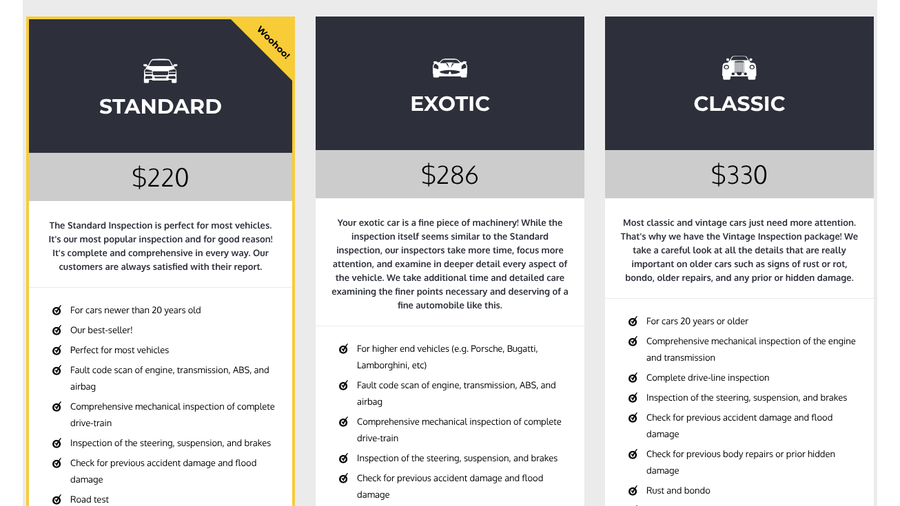
Every package lists a check for previous accident damage and flood damage. The Standard inspection covers cars newer than 20 years. It includes a fault code scan of the engine, transmission, ABS and airbag systems. Inspectors also check the drivetrain, steering, suspension and brakes, then finish with a road test and more than 25 pictures. The Classic package, for cars 20 years or older, adds rust and bondo checks and verifies engine and transmission numbers. That’s useful when you want proof that major parts belong to the car on the title.
The EV package checks the current charge level and estimated range, EV-specific electronics and the included charging cable. That’s lighter than a full battery health report. On a January 2026 Reddit thread, one EV buyer said their report had no battery or range information, and another said obvious EV checks were skipped.
Service complaints are the bigger concern. In January 2026, a buyer said they paid about $250 and the inspection was done by midday, but the report still hadn’t arrived 48 hours later. In July 2026, another said their inspection was rescheduled 10 times until the car sold. Scheduling depends partly on the seller, but if your deal is time-sensitive, confirm timing before paying.
- Pros: Packages for almost any vehicle type, flood damage checks on every package and an ASE Master Technician review.
- Cons: Recent complaints about late reports and rescheduling, and a higher Standard price than POMCAR or iNeedaPPi.
Pricing: $219.99 for Standard, $249 for EV and $210 for motorcycles. Exotic, classic, commercial and RV packages run $286 to $449.
4. A RepairPal Certified shop
Best for: Local private sales where the seller will drive the car to a shop.
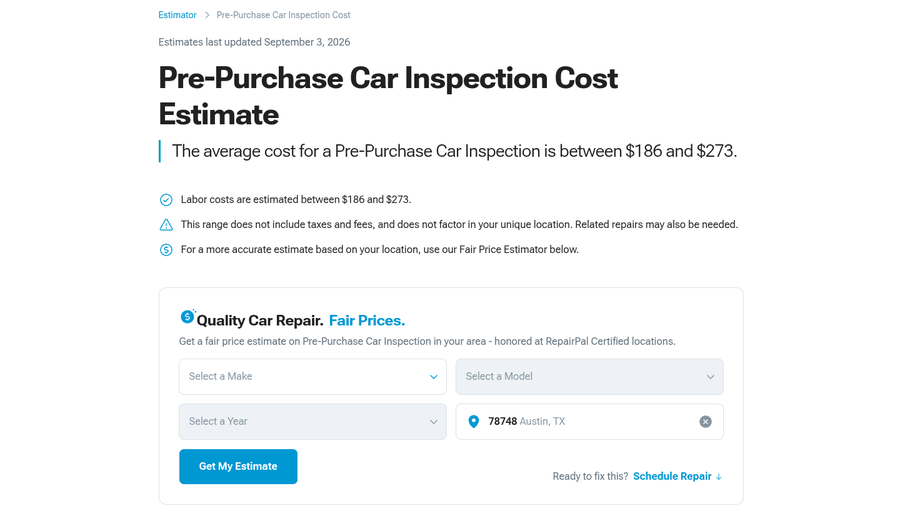
If the car is nearby, a shop inspection is often the most thorough choice. RepairPal’s estimator puts the average pre-purchase car inspection cost between $186 and $273 as of September 3, 2026, before taxes, fees and local pricing. Its Fair Price Estimator gives a local figure that RepairPal says is honored at RepairPal Certified locations.
The lift is the main advantage for flood checks. RepairPal says a shop has a lift that lets the mechanic get a good look at the underside of the vehicle. It adds that a mobile inspection is more convenient and quicker but may not be as thorough as one done in a shop. On a lift, rust and dried mud in odd places are easier to spot. RepairPal also recommends asking for an ASE-certified technician, or better yet an ASE-certified master technician.
Shop inspections don’t come with a standard checklist, so tell the shop exactly what you want. Ask them to compare the VIN on the dash and door jamb with the seller’s title, pull back carpet in a corner and look for silt in the spare tire well. A shop that specializes in the brand you’re buying can also spot model-specific problems a generalist might miss.
The hurdle is logistics. The seller has to agree to meet you at the shop, and some private sellers won’t. RepairPal’s view is direct: if a seller won’t allow a pre-purchase inspection, there’s a good chance they’re hiding a serious issue, and you should treat it as a red flag and walk away.
- Pros: Lift access for the underbody, a local fair price estimate and the option to choose a brand specialist.
- Cons: The seller must bring the car, and results depend on how clearly you spell out what to check.
Pricing: $186 to $273 on average, according to RepairPal’s September 2026 estimate.
5. YourMechanic
Best for: Buyers who want to pick their mobile mechanic based on experience and reviews.
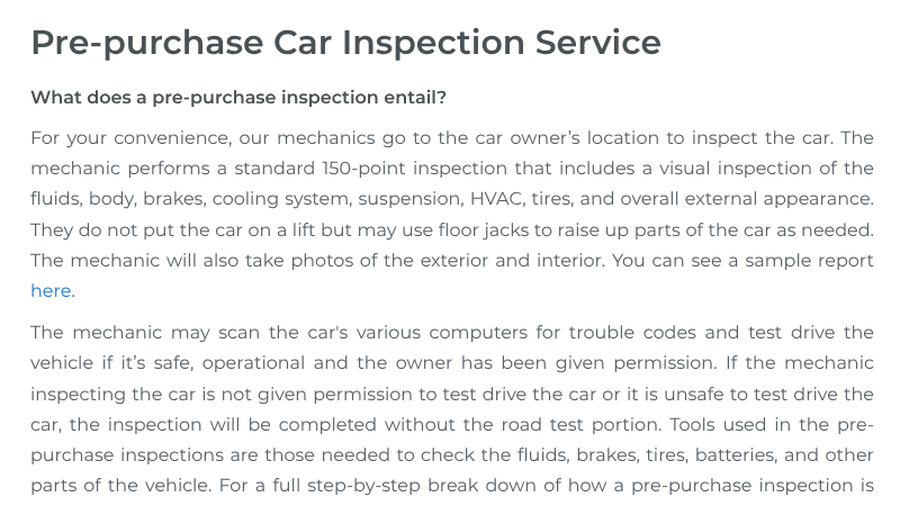
YourMechanic is a mobile repair marketplace that also books pre-purchase inspections. Its mechanics go to the car owner’s location and perform a standard 150-point inspection. It covers the fluids, body, brakes and cooling system. The suspension, HVAC, tires and overall appearance get checked too, and the mechanic photographs the exterior and interior. The mechanic may also scan the car’s computers for trouble codes and test drive it if it’s safe and the owner gives permission.
Choice is the draw. YourMechanic says its mechanics average more than ten years of experience and most are ASE-certified master technicians who pass background checks. Each one has a profile showing certifications, experience and customer feedback, so you can see who is coming. Mechanics work seven days a week from 7 a.m. to 9 p.m., which helps when a private seller is only free on a Sunday evening.
For flood concerns, know the limits. YourMechanic says its mechanics don’t put the car on a lift, though they may use floor jacks to raise parts of it. Add a note when you book asking the mechanic to check under the seats and carpets, smell for mildew and test every electrical feature, since flood damage often shows up in wiring first. It’s also worth asking whether pedal, seat and steering wheel wear fit the odometer reading. Our look at Carfax vs AutoCheck on odometer rollbacks covers what the reports can catch.
Pricing isn’t listed up front. You enter your ZIP code and vehicle to get a quote, which makes it harder to compare at a glance but reflects local labor rates.
- Pros: Mechanic profiles with certifications and reviews, and appointments seven days a week with long hours.
- Cons: No lift, no posted price and no road test without the owner’s permission.
Pricing: Quote-based by ZIP code and vehicle.
What to ask for in a pre-purchase inspection
Whoever you hire, give them a written list. NICB’s warning signs of flood damage include musty odors, water stains and rust. It also lists silt or mud, mismatched upholstery and moisture inside parts. Ask for these checks too:
- VINs on the dash, door jamb and title all match, along with the VIN reported by the car’s computer.
- Silt or a waterline under the seats, in the spare tire well and behind the dash panels.
- Rust on seat rails, pedal brackets and screws that should never see water.
- New carpet or upholstery in an otherwise worn car.
- Electrical faults such as flickering lights, dead switches or stored airbag codes.
Then check the paperwork yourself. The title should be in the seller’s name, and any lien should show a release. Our guide to DMV title transfer mistakes in private sales covers what to bring on the day you pay.
How We Chose These
We looked for inspection options a private-sale buyer can book today without a dealer involved. Nationwide or multi-city mobile services got priority, along with one shop-based route for buyers who can get the car to a lift. For each one, we compared posted prices and what the checklist covers, with extra weight on VIN verification, flood damage checks and underbody access. We also looked at how reports are delivered and how scheduling works with private sellers. We read recent buyer experiences to flag service problems, and we noted trade-offs where an option fell short.
The Bottom Line
If the car is local, get it on a lift at a trusted shop and hand over a written flood checklist. If it’s far away, POMCAR is the budget pick for nationwide coverage, and iNeedaPPi is the fastest option in the cities it covers. Lemon Squad makes sense for EVs, classics or RVs, but confirm the report timing first. Choose YourMechanic when picking the person matters most to you. Whichever you choose, pair it with a history report and walk away from any seller who refuses an inspection.
Frequently Asked Questions
What is the best pre-purchase inspection service?
The best pre-purchase inspection service depends on where the car is. A shop with a lift is best for local cars. For distant cars, POMCAR is the best budget nationwide option, and iNeedaPPi is fastest in the cities it covers.
How much does a pre-purchase inspection cost?
A pre-purchase inspection typically costs $180 to $275. RepairPal’s September 2026 estimate puts the average between $186 and $273, while mobile services on this list charge $180 to $219.99 for a standard car.
Can a pre-purchase inspection detect flood damage?
A pre-purchase inspection can often detect flood damage by checking for silt, rust in unusual places, musty odors and electrical faults. It isn’t guaranteed, so pair it with a vehicle history report and ask the inspector to focus on flood signs.
What is title washing?
Title washing is retitling a damaged car, often in another state, so a salvage or flood brand no longer shows on the new title. NICB warns that sellers use it with surface repairs to hide flood history from buyers.
What should I do if a private seller won’t allow an inspection?
If a private seller won’t allow a pre-purchase inspection, walk away. RepairPal calls a refusal a big red flag that the seller may be hiding a serious issue. There are other cars worth your money.