Six pay-per-use roadside assistance options that do not need a yearly membership, what each one charges, and what to tell the dispatcher if you drive an EV.
In March 2026, a Tesla owner on Reddit posted a guide they wished they had read before their car needed a tow. Tell the tow company it is an electric vehicle, they wrote, and whether it needs a flatbed. Say if you can turn on tow mode. Mention if you are in a parking garage, because a typical flatbed will not fit. Most drivers learn this the hard way, on the shoulder, often without a roadside plan at all. The good news is that pay-per-use roadside assistance means you can still get a tow, a jump or a lockout without paying for a membership you rarely use.
The best pay-per-use roadside assistance options in 2026 are:
- HONK: best app for upfront prices and live tracking
- Allstate Motor Club app: best big-network app you can use without joining
- Visa Roadside Dispatch: best fixed price for Visa cardholders
- American Express Roadside Assistance Hotline: best free dispatch for Amex Card Members
- Verizon Roadside Assistance: best for Verizon wireless customers
- iPhone Roadside Assistance via satellite: best when you have no cell signal
Quick Picks
| Option | Best For | Price | How You Request Help |
|---|---|---|---|
| HONK | Upfront app pricing | Shown in the app before you order | App |
| Allstate Motor Club app | Large provider network | Fees for non-members | App |
| Visa Roadside Dispatch | Visa cardholders | $79.95 per standard call | Phone |
| Amex Roadside Assistance Hotline | Amex Card Members | Free dispatch, you pay the provider | Phone |
| Verizon Roadside Assistance | Verizon customers | $95 to $159 per service | Phone, app or satellite |
| iPhone via satellite | No cell coverage | Provider quotes before dispatch | Satellite text |
Table of Contents
Why pay-per-use roadside assistance makes sense
A membership pays off if you break down often or drive an older car far from home. Many drivers do not. Newer cars, especially EVs, often come with roadside coverage from the carmaker for the warranty period, and plenty of drivers call for help once every few years. For them, paying only when something goes wrong is simpler. If you want an ongoing plan instead, our guide to AAA alternatives with EV-friendly towing compares membership and insurance options.
The trade-off is price per call. Verizon charges $159 for a pay-per-use tow. Its subscription costs $4.99 a month, about $60 a year. The math depends on how often you need help.
1. HONK
Best for: Drivers who want to see the price before anyone is sent.
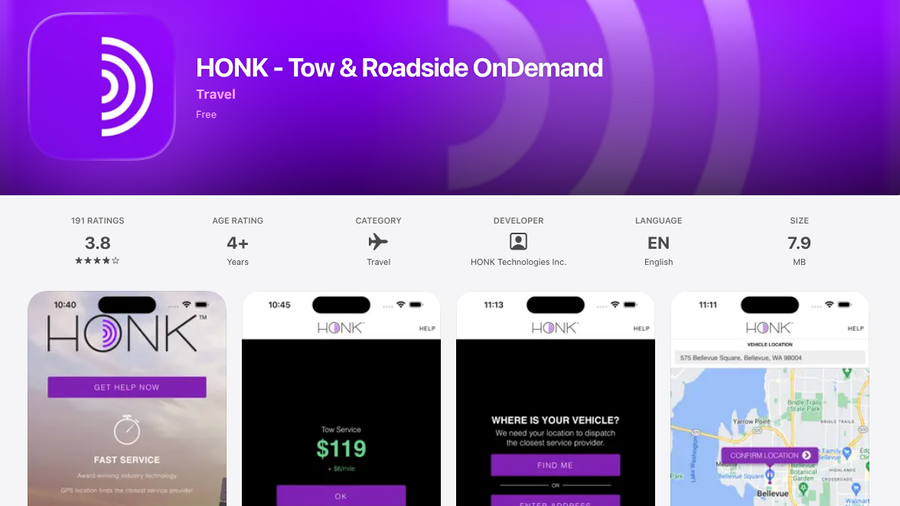
HONK is a roadside app that works like a ride-hailing service for tow trucks. You pick the problem, from a tow or flat tire to a dead battery or locked keys, and the app sends the closest available provider. Its App Store listing says there are no annual membership fees and that you will know the cost of every service before you order, paid by credit or debit card, with no need to negotiate with the driver.
The listing claims a network of more than 75,000 trucks nationwide and arrival times of 15 to 30 minutes, with updates, an estimated arrival time and the driver’s name and number. One of its store screenshots shows a tow quoted at $119 plus $6 per mile, which gives a sense of how prices appear, though your price depends on what you need and where you are. The app is still maintained, with an update released on September 1.
Reviews are mixed, and it is worth knowing why. The app holds a 3.8 rating from 191 ratings. One reviewer said it took three to four minutes to be matched with a driver and about 30 minutes for the driver to arrive. Another said they had been let down three times in a row and advised keeping enough funds to cover twice the towing cost. HONK’s help center also explains that a provider who finds more work is needed on scene can request additional charges, which HONK reviews using video evidence.
For EV drivers, HONK’s business site says it tailors roadside service for EVs, motorcycles and RVs. Still, select tow, say it is an electric vehicle in the notes and ask for a flatbed if your carmaker requires one.
- Pros: No membership, price shown before you order, live driver tracking and card payment in the app.
- Cons: Mixed reviews, on-scene extra charges are possible and EV handling depends on the local provider.
Pricing: Pay per service, with the price shown in the app before you confirm. Tow prices include a per-mile charge.
2. Allstate Motor Club app
Best for: Drivers who want a big roadside network without joining a club.
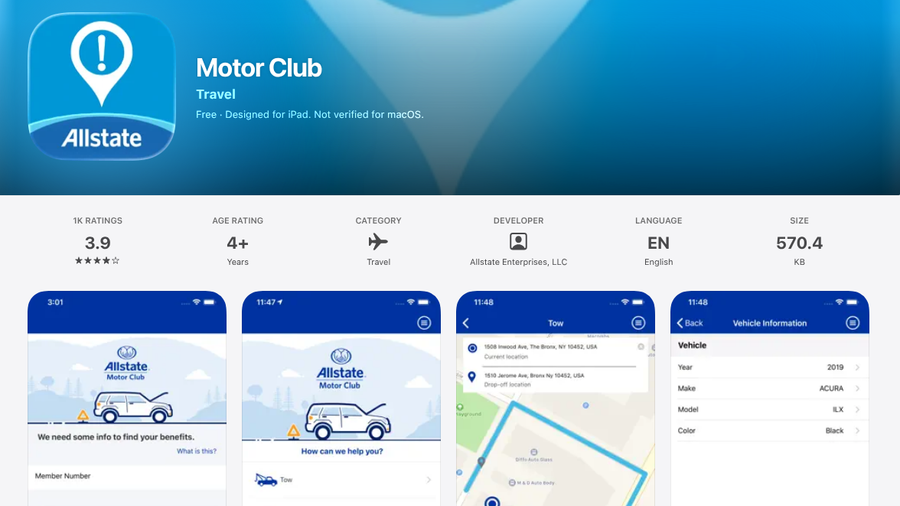
Allstate’s Motor Club app is built for members, but you do not have to be one to use it. Its App Store description says the app lets “any user” request roadside assistance through Allstate’s nationwide 24/7 provider network, using your phone’s GPS to route help to you. It adds that services for vehicles outside an Allstate Motor Club membership are subject to fees.
The feature list is practical for a stressful moment. The app tracks your location or lets you type an address, suggests drop-off locations and finds nearby Allstate service providers with the shortest estimated arrival times. It shows the provider’s company name, phone number and technician name, and it tracks your technician on a map. It can also email family or friends about your situation, and live customer service is available 24/7 if the request stalls.
The app holds a 3.9 rating from about 1,000 ratings and received a minor update in February. One long-time user praised the updates, arrival estimates and map but said the app sometimes got stuck with an error after the job finished. Another reviewer, a member since 1980, complained about how a local tow operator treated them, a reminder that the experience depends on whoever the network sends.
Because pricing for non-members is not published in the listing, confirm the fee in the app or with the representative before you accept. EV drivers should enter the vehicle details carefully and ask for a flatbed tow to a charger or service center.
- Pros: Large national network, GPS routing, technician tracking, family alerts and 24/7 human backup.
- Cons: Non-member fees are not listed upfront in the store description, and service quality varies by local provider.
Pricing: Free app. Non-members pay fees for each service.
3. Visa Roadside Dispatch
Best for: Visa cardholders who want one phone number and a set price.
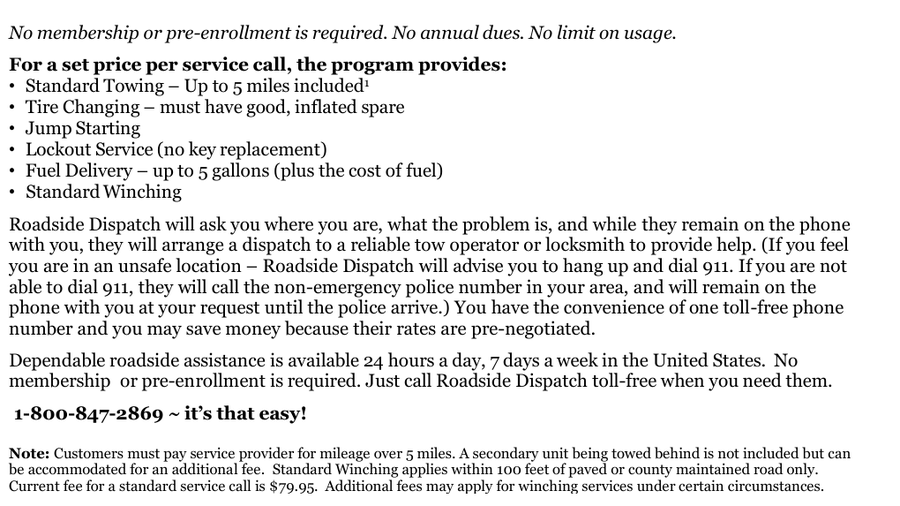
Visa’s Roadside Dispatch program is a pay-per-use service built into many Visa cards, including Visa Signature and Visa Infinite. The terms say no membership or pre-enrollment is required, there are no annual dues and there is no limit on usage. You call 1-800-847-2869, and while you stay on the line, the dispatcher arranges a tow operator or locksmith.
The current fee for a standard service call is $79.95. That covers a tow of up to 5 miles, a tire change if you have a good spare and a jump start. It also includes lockout service without key replacement, up to 5 gallons of fuel plus its cost, and standard winching within 100 feet of a paved or county-maintained road. You pay the provider for mileage beyond 5 miles. Fees can change, but the terms say callers are told the price before anyone is dispatched.
Coverage applies to light-duty vehicles weighing 10,000 pounds or less, which includes most passenger EVs. There is a useful safety rule, too: if you feel unsafe, the dispatcher will tell you to hang up and call 911, and if you cannot, it will call the non-emergency police number and stay on the line.
Two more lines in the terms deserve attention. Roadside Dispatch is run by Cross Country Motor Club, which does business as Agero. And you are responsible for charges from a provider who responds to your request even if you are not with your vehicle or it is gone when they arrive, so cancel promptly if plans change.
For EVs, the 5-mile towing allowance is the catch. The nearest charger or service center may be farther, so ask about the per-mile rate and request a flatbed before you agree.
- Pros: No enrollment, a known base price, unlimited use and a clear safety policy.
- Cons: Only 5 miles of towing included, phone-only requests and extra charges for longer tows.
Pricing: $79.95 per standard service call, plus mileage over 5 miles and any extra winching fees.
4. American Express Roadside Assistance Hotline
Best for: Amex Card Members who want help finding a provider and are fine paying the provider directly.
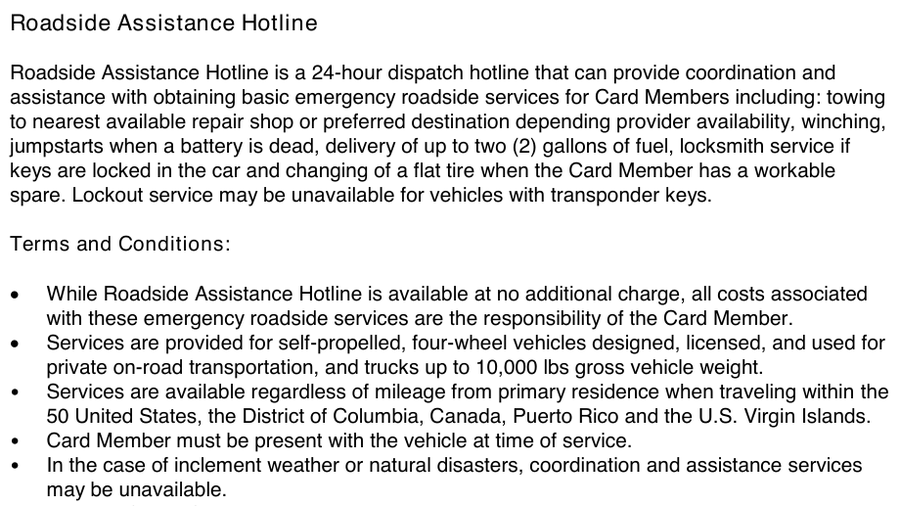
American Express offers eligible Card Members a 24-hour Roadside Assistance Hotline. According to its terms, the hotline coordinates towing to the nearest available repair shop or a preferred destination. It also arranges winching, jump starts, up to two gallons of fuel, locksmith service and tire changes when you have a workable spare.

The key difference from Visa’s program is how pricing works. The hotline itself costs nothing extra, but all costs for the roadside services are the Card Member’s responsibility. In practice, you get dispatch help without a set fee, and you pay whatever the provider charges.
The fine print matters for newer cars. Lockout service may be unavailable for vehicles with transponder keys. Coverage applies to four-wheel passenger vehicles and trucks up to 10,000 pounds gross vehicle weight, and rental vehicles, motorcycles and taxis are excluded. The Card Member must be with the vehicle. Help is available across the 50 states and Washington, D.C., plus Canada, Puerto Rico and the U.S. Virgin Islands. The terms also warn that coordination may be unavailable during severe weather or natural disasters, and that service on roads with limited provider access may not be possible. For questions about the program, the terms list 855-431-1156 or the number on the back of your card.
For an EV, the option to tow to a preferred destination is useful, because you can ask to go to a charger or service center rather than the nearest repair shop. Confirm the price and the truck type with the provider before it rolls.
- Pros: Free dispatch, towing to a preferred destination and coverage across the U.S. and Canada.
- Cons: No set price, lockout may not work with transponder keys and rental cars are excluded.
Pricing: The hotline is free. You pay the provider’s charges.
5. Verizon Roadside Assistance
Best for: Verizon wireless customers who want published prices.
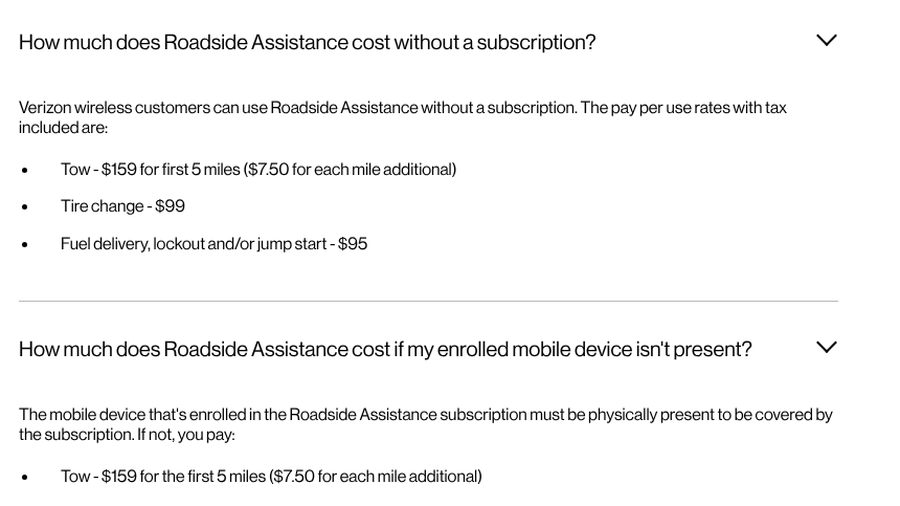
Verizon customers can use its roadside service without a subscription. The Verizon roadside FAQ lists pay-per-use rates with tax included: $159 for a tow covering the first 5 miles, plus $7.50 for each additional mile, $99 for a tire change and $95 for fuel delivery, a lockout or a jump start.
If you would rather have coverage, Verizon also sells a subscription for $4.99 a month per line. The FAQ says it includes towing of up to 10 miles in coverage areas and winching up to $100. Jump starts, tire changes, lockout help and up to 2 gallons of fuel are covered too. The enrolled phone has to be with you at the time of service, or you pay the pay-per-use rates.
Verizon’s FAQ says its roadside help covers any eligible vehicle you are driving or riding in, including electric vehicles and motorcycles. It excludes RVs, boats and trailers, along with commercial vehicles and anything heavier than 10,000 pounds gross vehicle weight. In a coverage area, you can request help online, dial #ROAD (#7623) from your enrolled phone or call 1-87-ROADSIDE from any phone.
Verizon also connects to Apple’s satellite roadside feature. Apple says iPhone 14 and later models with a Verizon SIM and iOS 17.2 or later can reach Verizon’s roadside service via satellite when there is no cell signal, which helps on remote stretches.
For EV owners, the 5-mile tow limit at the base rate is again the thing to plan around. Fuel delivery does not help an EV that has run out of charge, so ask for a tow to the nearest compatible charger.
- Pros: Published prices with tax included, an optional low-cost subscription and satellite access on newer iPhones.
- Cons: Only for Verizon wireless customers, tows beyond 5 miles add up and the subscription requires the enrolled phone.
Pricing: $95 to $159 per service without a subscription, or $4.99 a month per line with one.
6. iPhone Roadside Assistance via satellite
Best for: Road-trippers who drive through areas with no cell coverage.
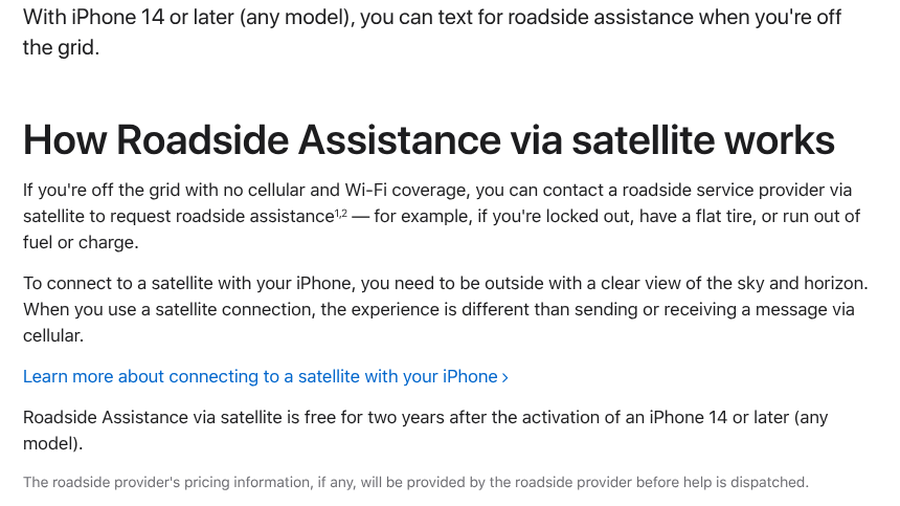
If you have an iPhone 14 or later, you already have a way to ask for help when there is no signal. Apple’s support page says you can text a roadside service provider via satellite when you have no cellular or Wi-Fi coverage, for example if you are locked out, have a flat tire or run out of fuel or charge. That last word matters for EV drivers.
The satellite feature is free for two years after you activate an iPhone 14 or later. The roadside help itself may cost money: Apple says the provider’s pricing, if any, is shown before help is dispatched. In the United States, the providers are AAA and Verizon. Existing members use their coverage, and anyone else sees the provider’s price before help is sent.
Using it takes some preparation. You need a clear view of the sky and horizon, and on iOS 18 or later you open Connection Assistant from Control Center or Settings, then choose Roadside Assistance. You can also type “Roadside” in a new message when you are off the grid. The feature works in the United States, including Puerto Rico, the United Kingdom and Australia. You need an active SIM, and Apple notes that some roadside providers might not support every state or territory.
Before a remote trip, try Apple’s satellite demo so the steps feel familiar. Our list of EV trip-planning mistakes covers how to avoid running low between chargers in the first place.
- Pros: Works with no cell signal, covers running out of charge and includes pricing before dispatch.
- Cons: Requires iPhone 14 or later, a clear view of the sky and is slower than a phone call.
Pricing: Satellite access is free for two years after activation. Roadside providers quote their price before sending help.
What EV drivers should tell any roadside provider
Whichever option you use, the call goes better if you give the dispatcher the details a tow operator needs. The March 2026 Reddit guide boils it down to a short script:
- Say it is an electric vehicle. Ask for a flatbed if your carmaker requires one.
- Mention tow mode. Say if the car can go into tow mode, since some EVs need power to release the parking brake.
- Describe the location. A standard flatbed will not fit in most parking garages, so a smaller truck may be needed first.
- Name the destination. If the battery is empty, ask for a tow to a charger that works with your car, not a repair shop.
If your car uses a different charging port than the nearest station, our guide to NACS adapter alternatives can help you avoid a second tow.
How We Chose These
We looked for roadside options that anyone in the United States can use without buying a yearly membership. Each pick had to publish how it works and how you pay, whether that is an app, a card benefit or a phone carrier program. We favored options with clear or upfront pricing, national provider networks and around-the-clock availability. We also checked what each covers for electric vehicles, including tow distance, destination choice and vehicle limits, and we read recent user reviews to spot recurring problems.
The Bottom Line
You do not need a membership to get help on the road. If you want an app with upfront prices, start with HONK. If you carry a Visa card, Roadside Dispatch gives you a known $79.95 base fee, and Verizon customers get published rates. For remote drives, an iPhone 14 or later can summon help by satellite. Whichever you choose, save the number or app before you need it, and if you drive an EV, ask for a flatbed and a tow to a charger.
Frequently Asked Questions
What is the best pay-per-use roadside assistance?
The best pay-per-use roadside assistance for most drivers is HONK, because it shows the price in the app before you order and needs no membership. Visa cardholders can use Visa Roadside Dispatch for $79.95 per standard call instead.
Can I get roadside assistance without a membership?
Yes, you can get roadside assistance without a membership. Pay-per-use apps like HONK and the Allstate Motor Club app work for anyone, and Visa, American Express and Verizon offer programs for their customers.
How much does pay-per-use roadside assistance cost?
Among the options in this guide, pay-per-use roadside assistance costs about $80 to $160 for a basic call. Visa Roadside Dispatch charges $79.95 per standard call, and Verizon charges $95 for a jump, lockout or fuel delivery and $159 for a tow of up to 5 miles.
Does roadside assistance work for electric cars?
Roadside assistance works for electric cars, but a jump or fuel delivery will not fix an empty battery. Tell the provider it is an EV, ask for a flatbed if your carmaker requires one and request a tow to a compatible charger.
Can I call roadside assistance with no cell signal?
You can request roadside assistance with no cell signal if you have an iPhone 14 or later. Its satellite feature connects you to AAA or Verizon in the United States, and the provider shares its price before sending help.
Related Posts