
Core Web Vitals pass rates for 2026 from real Chrome users on mobile. We compare page builders and hosted platforms first, then look at fonts, chat widgets and cookie banners.
In July 2026, a site owner on Reddit explained why they had moved their company site off WordPress and onto Astro: an agency had quoted $2,000 to fix its Core Web Vitals. One of the first replies wasn’t a defense of WordPress. It told them they could have kept WordPress and removed only Elementor, “one of the heaviest plugins out there.”
That’s a strong claim, so we checked it against real-user data. The numbers mostly back it up, with a few surprises about fonts, chat widgets and cookie banners along the way.
Short Answer
In August 2026, 53.0% of the 8.7 million websites in Chrome’s real-user data passed all three Core Web Vitals on mobile, up from 50.8% a year earlier. WordPress sites passed at 48.7%. Elementor sites passed at 36.8%, while sites built with WordPress’s own block editor passed at 61.0%. Hosted builders did far better, led by Duda at 86.0%. Loading speed is the metric most sites fail, and live chat widgets drag down responsiveness more than any font choice.
Table of Contents
How these numbers were measured
Every figure in this article comes from HTTP Archive’s Core Web Vitals technology report, pulled for the August 2026 dataset. It joins the Chrome UX Report, which records how real Chrome users experience a site, with detection of the technologies each site runs.
A site passes when it hits Google’s Core Web Vitals thresholds at the 75th percentile of visits. That means Largest Contentful Paint (LCP) within 2.5 seconds, Interaction to Next Paint (INP) under 200 milliseconds and Cumulative Layout Shift (CLS) under 0.1. All figures here are for mobile.
One caution before the tables. These are correlations. A tool with a low pass rate may simply be popular with sites on cheap hosting, and it may not be the cause.
Core Web Vitals pass rates by page builder
| Builder | Sites measured | Pass all 3 | Good LCP | Good INP | Good CLS |
|---|---|---|---|---|---|
| Gutenberg (block editor) | 21,996 | 61.0% | 68.2% | 93.1% | 87.4% |
| Breakdance | 5,326 | 57.0% | 61.5% | 94.6% | 93.2% |
| Bricks | 10,776 | 55.7% | 60.1% | 93.3% | 93.7% |
| Beaver Builder | 29,775 | 54.0% | 58.8% | 95.6% | 89.5% |
| All WordPress sites | 2,752,367 | 48.7% | 55.8% | 90.8% | 87.2% |
| Divi | 158,316 | 41.7% | 49.0% | 94.8% | 80.8% |
| WPBakery | 227,541 | 38.6% | 44.8% | 92.2% | 83.3% |
| Elementor | 912,385 | 36.8% | 41.5% | 88.9% | 88.6% |
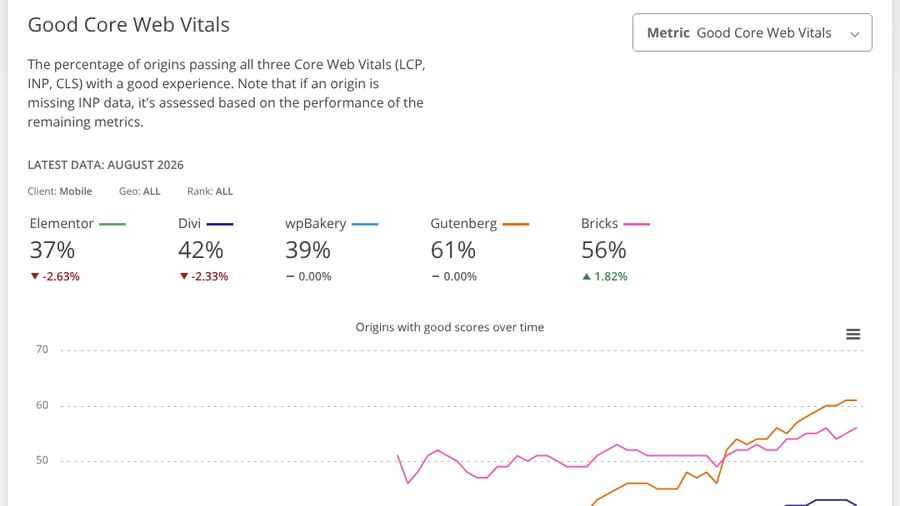
Look at the LCP column. Nearly every builder handles interactions and layout stability well, with INP above 88% across the board. The split happens on loading. Only 41.5% of Elementor sites load their main content within 2.5 seconds for three in four visits, compared with 68.2% of block editor sites. Elementor has improved, from 33.7% passing a year earlier, but the block editor climbed faster, from 53.8% to 61.0%.
Slider Revolution, often bundled with premium themes, sits at 35.8%, lower than any builder in the table. A full-width slider in the hero is usually the largest element on the page, which makes it the thing LCP measures.
Popularity plays a part too. With more than 900,000 sites, Elementor covers everything from careful agency builds to one-click installs on the cheapest shared plans. Commenters in an April 2026 r/Wordpress thread on red mobile LCP scores kept pointing at the same culprits: a lazy-loaded hero image and a slow server response. If you’re weighing a rebuild, our look at Elementor alternatives for WordPress compares the options.
Hosted site builders pass far more often
The gap widens outside WordPress. Duda passed at 86.0%, GoDaddy’s website builder at 83.8% and Wix at 81.2%. Shopify stores passed at 76.5%, Squarespace at 72.1%, Webflow at 71.2% and Framer at 70.6%.
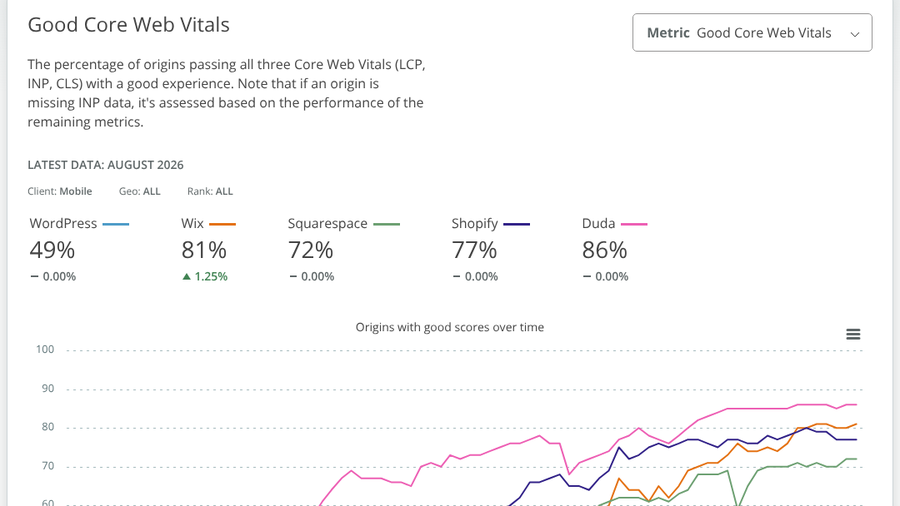
Squarespace made the biggest jump of any platform here, up from 58.6% in August 2025. Hostinger’s website builder went the other way, slipping from 59.1% to 54.7%. The pattern makes sense. Hosted platforms control the server, the image pipeline and the template code, which leaves less room for a slow plugin stack. The trade-off is less control and a harder move if you ever leave.
Do fonts break Core Web Vitals?
Less than their reputation suggests. Across 3.85 million sites loading Google Fonts through Google’s API, 48.8% passed, almost exactly the WordPress average. Adobe Fonts sites passed at 60.9%.

Loading habits have also caught up. According to the Web Almanac 2025 fonts chapter, 50.1% of mobile sites use font-display: swap, which shows fallback text while the web font loads. Another 24.9% use block, but the chapter traces about 70% of that to icon fonts, where a short delay beats a broken icon. Only 11.7% of mobile pages preload a font file.
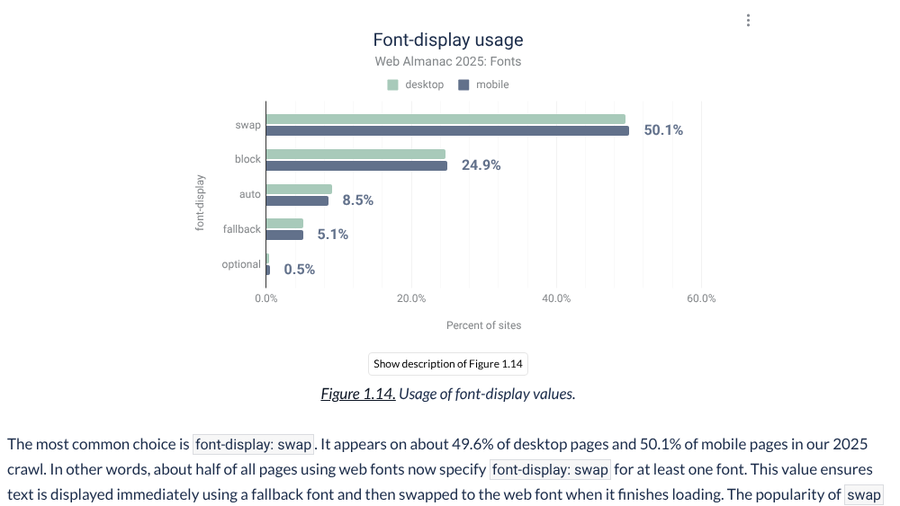
Fonts matter most when your largest element is a headline rather than an image. In that April thread, a site owner using Montserrat described the text reshaping the layout on mobile once the font arrived. That’s the swap trade-off in action. The fix is to preload the one font used above the fold and serve it as WOFF2. A fallback font sized to match keeps the reflow small.
Chat widgets and cookie banners hit responsiveness hardest
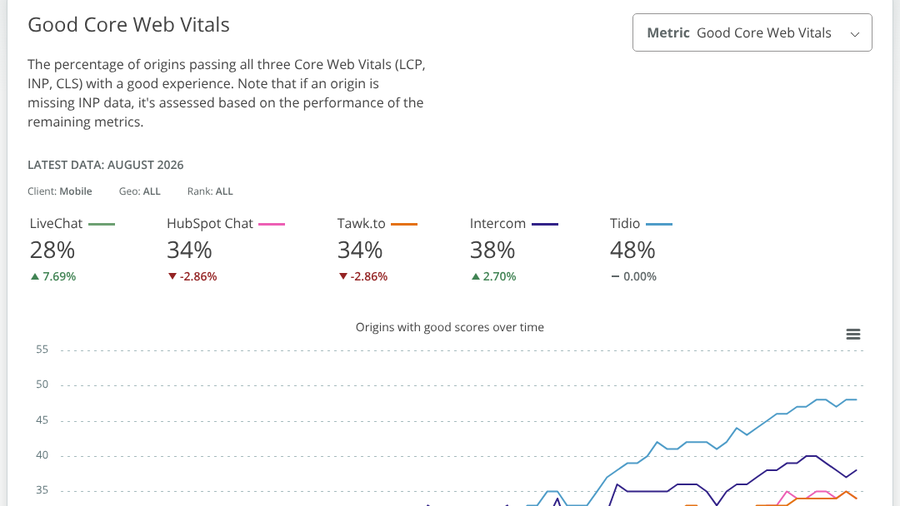
This is where the data gets ugly. Across all sites, 80.1% have good INP on mobile. Live chat widgets pull that down sharply:
- LiveChat: 27.6% pass all three, with only 54.2% good INP and 52.5% good CLS.
- HubSpot Chat and Tawk.to: 34.1% and 34.4% pass.
- Intercom: 37.9% pass, with 61.0% good INP.
- Tidio: 48.4% pass, the best of the group.
Consent tools vary more than you’d expect. Didomi sites passed at 36.3%, with good INP on only 46.4% of them. OneTrust sat at 42.7%, while CookieYes and Complianz both landed at 46.0%. Cookiebot reached 57.3% and Usercentrics 62.0%. Cloudflare’s Rocket Loader, sold as a speed feature, came in at 35.6%.
Again, cause is hard to prove here. Sites that add live chat tend to be commercial sites with plenty of other scripts. Still, a chat widget that loads its full JavaScript bundle on every page view is a known INP risk. Load it only when someone taps a chat button. Then test your cookie banner on a mid-range Android phone, not a new iPhone. If the banner exists mainly for analytics cookies, our roundup of cookieless GA4 alternatives covers tools that set none.
Does the Lighthouse score even matter?
Not the way most client reports suggest. In an August 2026 r/TechSEO post, one analyst ran 39 sites through the PageSpeed Insights API. Of the 22 that scored under 50 in Lighthouse, 8 passed all three Core Web Vitals with real users. By their count, the Lighthouse score had a -0.06 correlation with real-user LCP, which is no relationship at all.
Google’s own documentation says good Core Web Vitals align with what its core ranking systems seek to reward, but that’s the field data, not the lab score. Check the “real users” section of PageSpeed Insights or the Core Web Vitals report in Search Console. Your theme choice matters too. Our comparison of block themes and classic themes covers how each handles plugin updates.
What To Know
- 53.0% of sites passed Core Web Vitals on mobile in August 2026, and WordPress sites passed at 48.7%.
- Elementor passed at 36.8% and the block editor at 61.0%. Loading speed (LCP) explains most of that gap.
- Hosted builders passed between 70.6% (Framer) and 86.0% (Duda).
- Google Fonts sites pass at roughly the WordPress average, so preload one above-the-fold font before you blame fonts.
- Live chat widgets and some consent tools have the weakest INP. Load chat on click and test banners on a mid-range phone.
Frequently Asked Questions
What are Core Web Vitals?
They are three Google metrics for real-user experience: Largest Contentful Paint for loading, Interaction to Next Paint for responsiveness and Cumulative Layout Shift for visual stability. A page passes when 75% of visits hit 2.5 seconds, 200 milliseconds and 0.1 or better.
What percentage of websites pass Core Web Vitals in 2026?
HTTP Archive’s August 2026 data shows 53.0% of websites passing all three Core Web Vitals on mobile, up from 50.8% in August 2025. WordPress sites passed at 48.7%.
Does Elementor hurt Core Web Vitals?
Elementor sites pass less often than average, at 36.8% on mobile versus 48.7% for WordPress overall. Most of the gap is slow loading of the main content. Some well-hosted Elementor sites do pass, but block-based builds pass far more often.
Does font-display swap help Core Web Vitals?
It shows text right away in a fallback font, which helps loading when a headline is the largest element. It can cause a small layout shift when the web font arrives, so preload that font and match the fallback’s size.
How do I check my site’s Core Web Vitals?
Run your URL through PageSpeed Insights and read the real-user section at the top, or open the Core Web Vitals report in Google Search Console. Sites with too little Chrome traffic won’t have real-user data.
What This Means
What you build on sets your starting odds more than any optimization plugin. If your WordPress site fails on mobile, fix the hero image and server response first. Then look hard at the page builder and the chat widget. Fonts are rarely the whole story.
Related Posts